Laboratory Software Development Services
We build custom software for clinical diagnostic labs, pharma R&D, biobanks, and diagnostic networks, streamlining sample-to-result workflows, meeting CAP/CLIA and 21 CFR Part 11 requirements, and integrating with any instrument or EHR.
Discuss your lab project
Lab automation software built for data integrity, not just speed
Laboratory software sits at the intersection of data integrity, instrument connectivity, and regulatory compliance: a small error in sample tracking or result transcription doesn't stay small; it becomes a misdiagnosis, a failed audit, or a recalled batch. We build for that environment from the first architecture decision, not after a validation team flags a gap. Every system we ship carries the chain-of-custody, audit trail, and access control logic a lab actually gets inspected on. That's the standard we hold custom LIMS, LIS, and lab data platforms to, whether the client is a diagnostic network or a Series B biobank.
Services we offer
We cover the full range of laboratory software development and LIMS consulting, from building a LIMS from scratch to modernizing a legacy LIS your team can no longer extend.
Discuss your lab project
Custom LIMS development
We build a LIMS system from scratch that automates sample tracking and data management across your sample lifecycle. Inventory management and workflow rules match how your lab actually operates, helping reduce manual errors instead of forcing a generic template.
Custom LIS development
We build LIS software for clinical settings like order intake, result reporting, and EHR bridge via HL7 or FHIR. The workflow follows how orders move from clinician to bench to report, not a one-size configuration.

LIMS / LIS integration
We connect your LIMS or LIS to EHRs, instruments, cloud infrastructure, billing, and other systems. Integration work follows the same validation rigor as new development, reducing automation issues in laboratory data management when data moves between platforms, so nothing breaks the audit trail on either side.

Lab data analytics and reporting
We build dashboards and audit-ready exports that turn sample and result data into regulatory reports, with automated report generation and document management, and data visualization for turnaround time, instrument utilization, QC trends without a manual spreadsheet pass.

Legacy system modernization
We extend or migrate an existing LIS or LIMS without a full replacement or a disruption to live operations. Most labs don't need to start over. They need an API layer, a data model fix, or a phased migration path.

Lab software consulting
We advise on architecture, integrations, and which pieces to build custom versus adopt from proven components. Most labs land somewhere between fully custom and off-the-shelf, and we help find the right mix for your budget and compliance needs.
Our clients say it better






Lab software solutions we build
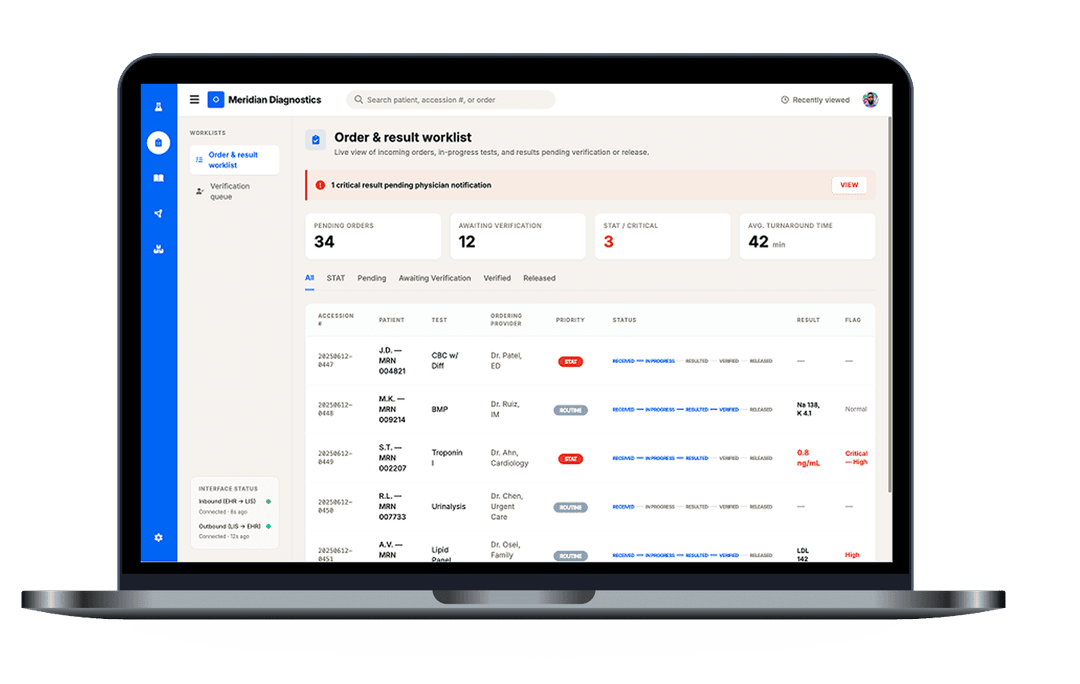
Every lab runs on a different mix of these four systems, depending on whether it's diagnosing patients or running R&D assays. We build each one standalone or as part of a connected stack.
LIMS (Laboratory Information Management System)
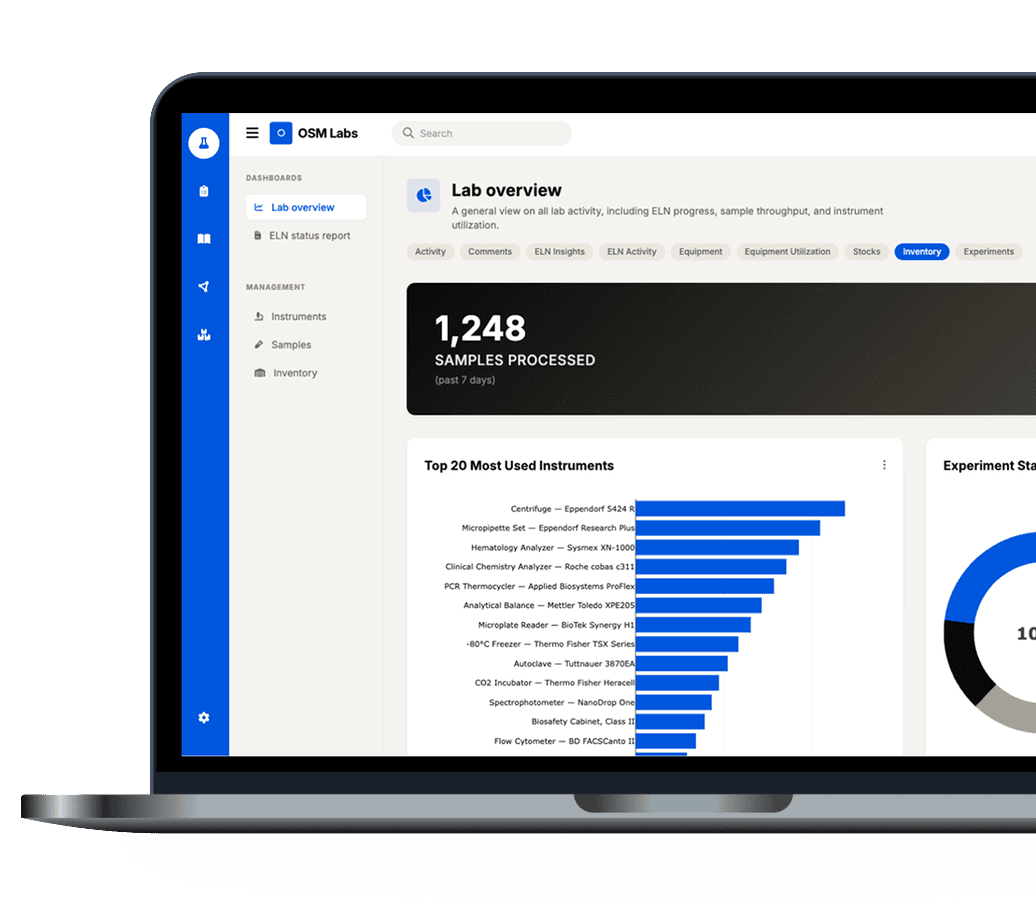
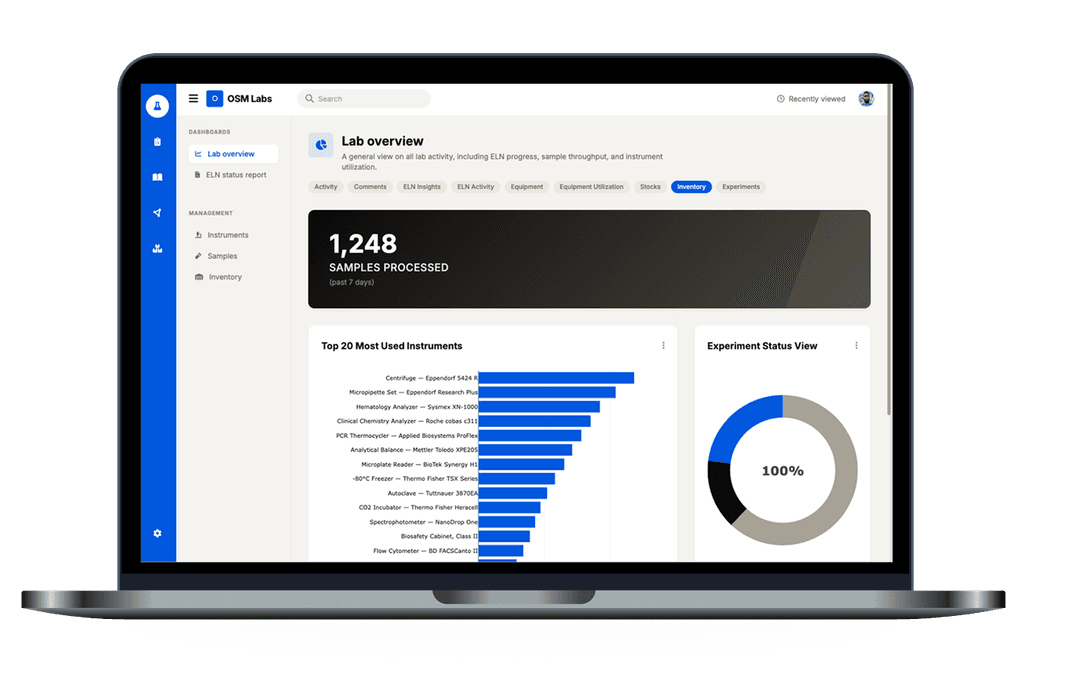
A LIMS is a software platform that manages samples, associated data, and laboratory workflows from receipt through disposal.
We build LIMS software that tracks a sample through every stage of its lifecycle (accessioning, chain-of-custody, QC checkpoints, storage location, and disposal) with an audit trail attached to each step. Configurable workflow rules match your lab's protocols instead of forcing a generic sample-tracking template onto them.
LIS (Laboratory Information System)
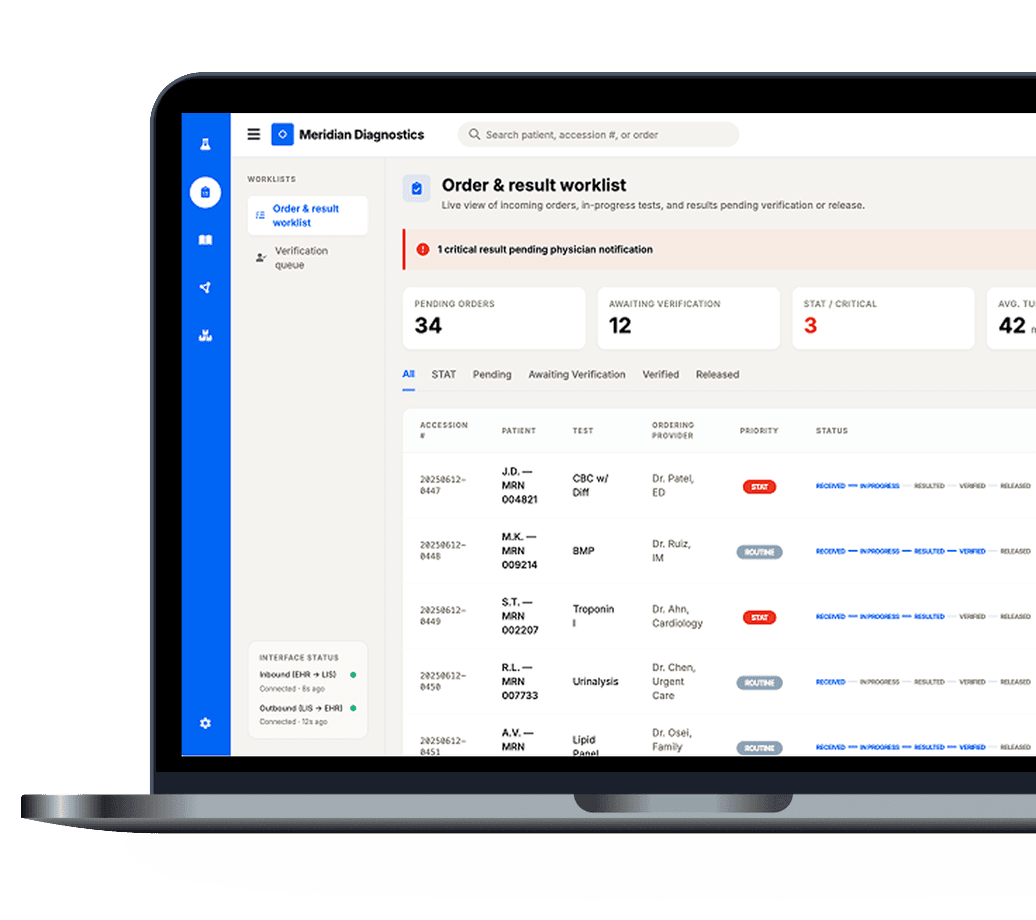
A LIS is a software system used in clinical laboratories to manage patient orders, test results, and communication with EHR systems via HL7 or FHIR.
We build LIS software that manages the clinical order-to-result cycle — order intake from the EHR, result entry and verification at the bench, and structured result delivery back to the ordering clinician. HL7 v2.x and FHIR R4 interfaces keep that exchange bidirectional instead of a one-way data drop.
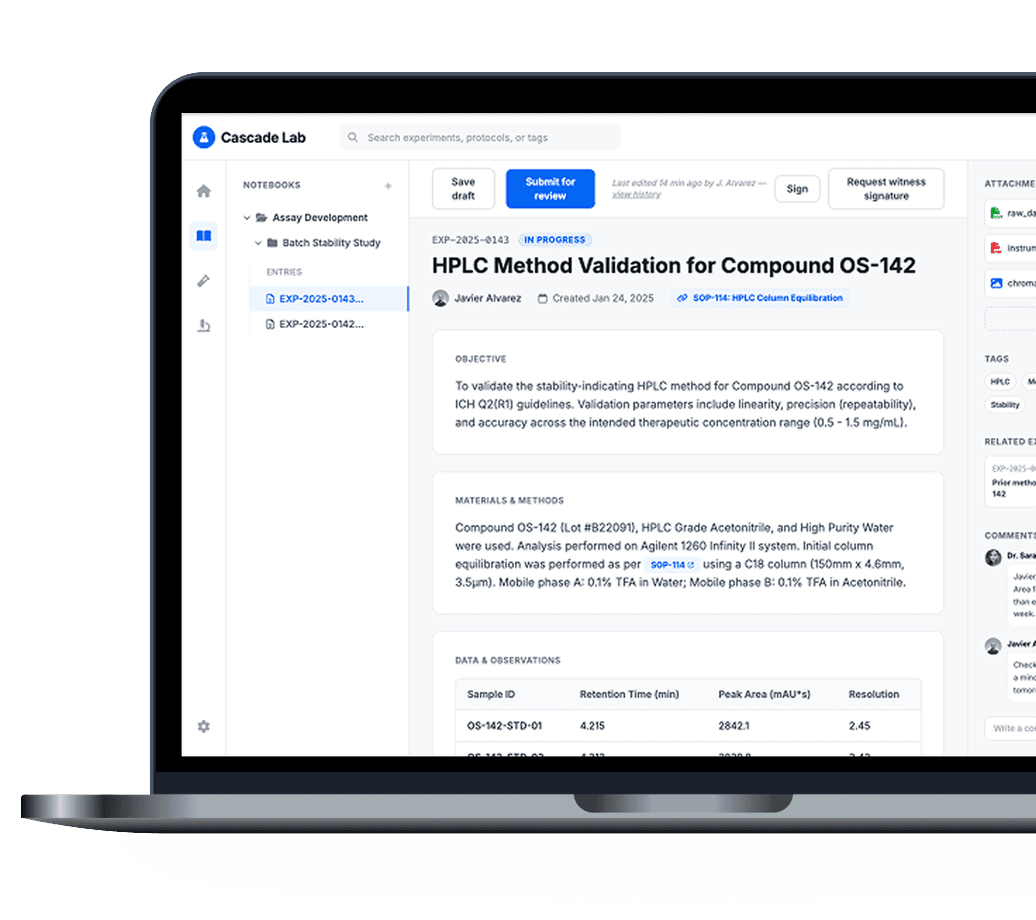
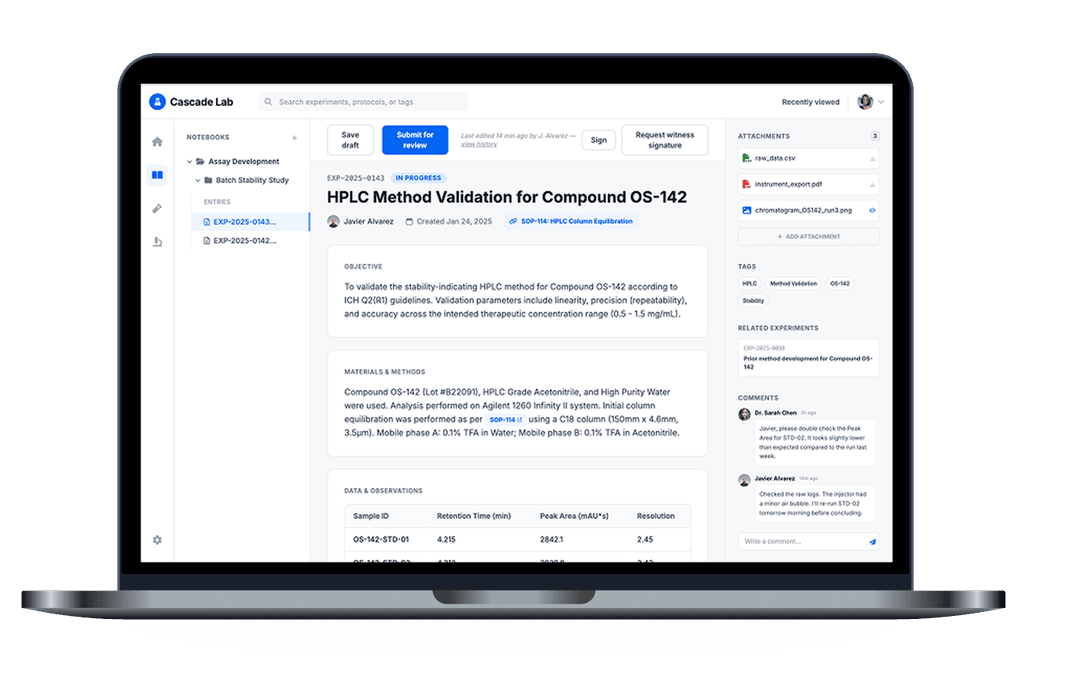
ELN (Electronic Laboratory Notebook)
An ELN is a digital platform that replaces paper notebooks in research labs, capturing experiment protocols, raw data, and observations in a structured, auditable format.
We build ELN software that captures experiment protocols, raw data, and observations in a format a reviewer or auditor can reconstruct later, not a free-text notebook with a login screen. Version control and electronic signatures on each entry keep the record defensible under GLP review.
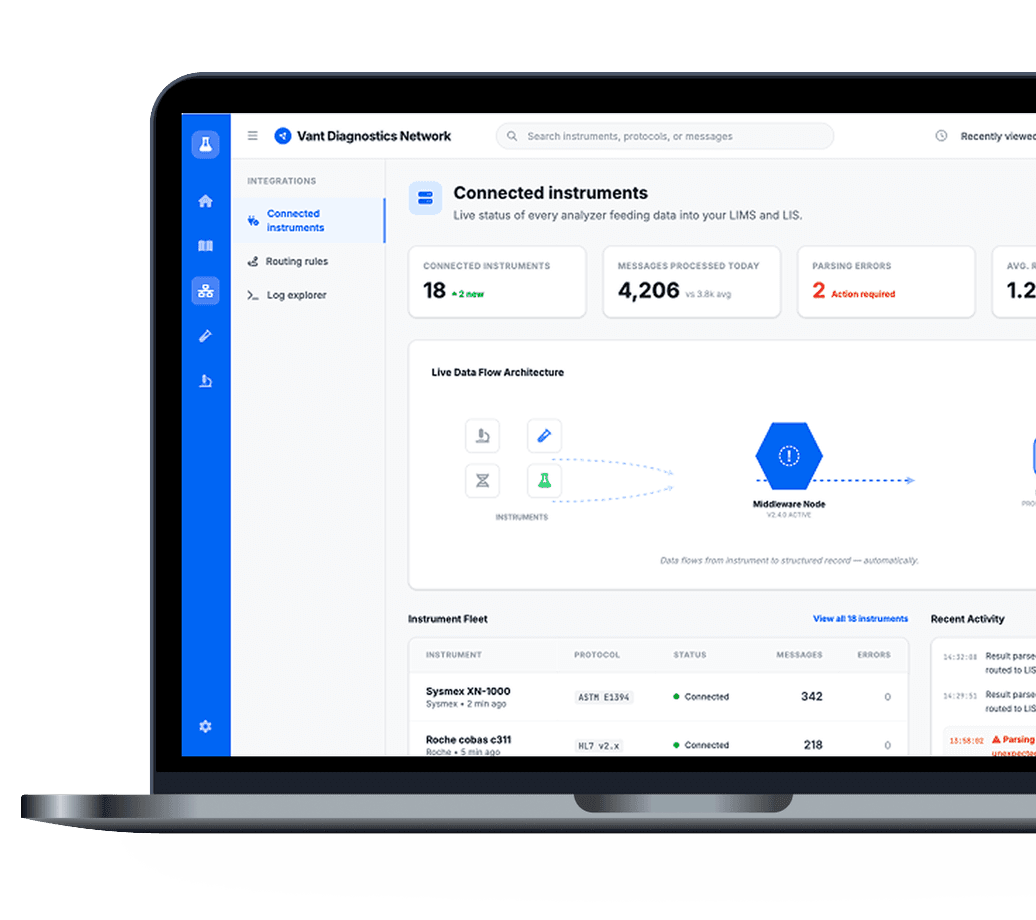
Lab automation and middleware
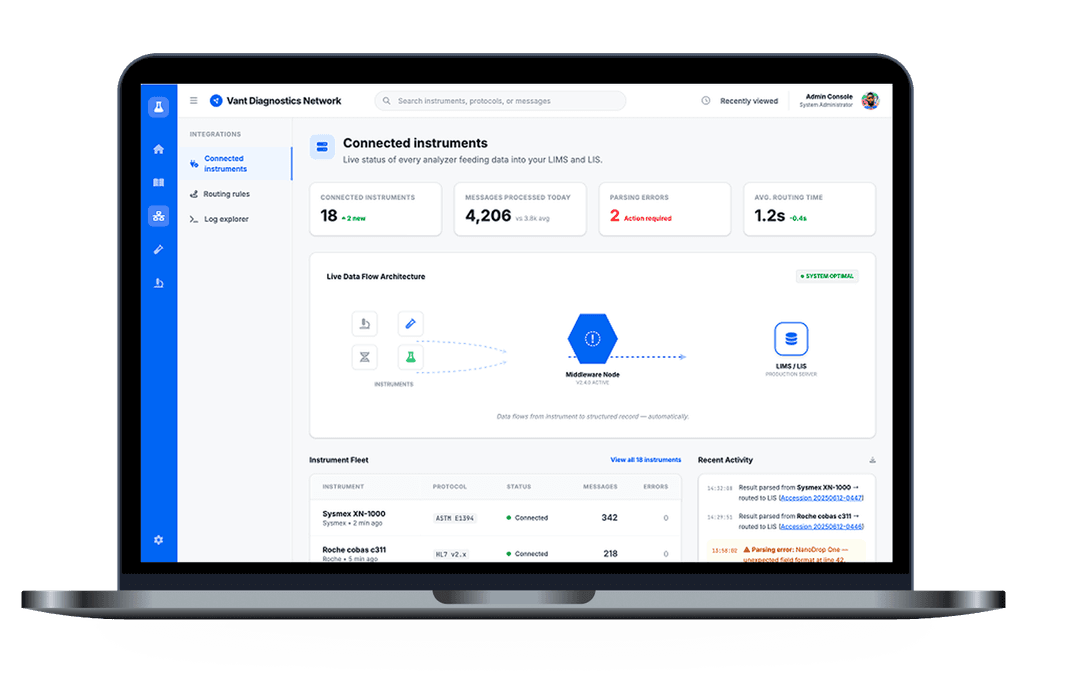
Lab automation uses middleware to connect instruments and analyzers from different manufacturers, standardize their output, and route it to a LIMS or LIS without manual entry.
We build middleware that parses raw instrument output and routes structured results to the right record automatically, removing the manual re-entry step that slows turnaround time in labs running multiple analyzer models. It's typically the single biggest source of delay we find when we audit a lab's existing workflow.
Integrations for a connected lab
A lab's data doesn't live in one system. Results have to move between the LIMS or LIS, the ordering EHR, the instrument fleet, billing and public health reporting, without a manual re-entry step at every handoff. Each of those handoffs is also where data integrity breaks down if it isn't built correctly.
EHR / EMR integration
We build bidirectional order/result exchange with Epic, Cerner, or any HL7 and FHIR-compliant system, so a clinician's order reaches the bench and the result reaches the chart without manual transcription.
Laboratory instrument connectivity
We build direct interfaces to hematology, chemistry, and microbiology analyzers using ASTM E1381/E1394 and LIS middleware, so instrument output flows straight into the record instead of getting keyed in by hand.
Cloud and infrastructure
We build on AWS or Azure for scalable storage, audit logging, and disaster recovery, so a lab's historical data survives a hardware failure and stays queryable for as long as regulators require it.
LIMS-to-EHR bridge
We build the bridge that lets a lab add clinical result reporting to an existing LIMS without replacing it, which is useful for R&D-first labs that are expanding into clinical work and don't want a second system.
Billing and RCM integration
We connect lab results to revenue cycle systems, payer APIs, and claims workflows, so a completed test doesn't sit unbilled because the result and the claim live in two disconnected systems.
Public health reporting
We build electronic lab reporting (ELR) pipelines to state and federal health agencies, formatted to what each agency's intake system expects, so a reportable result doesn't require a manual submission process.
AI-assisted laboratory workflows
We integrate AI capabilities where they reduce manual load and improve data reliability. Each addition is an engineering decision made together with your lab team, not a default feature.
Automated QC anomaly detection
We build models that flag out-of-range results or instrument drift before they reach a patient report, catching the kind of error a manual QC review sometimes misses under volume.
Predictive instrument maintenance
We surface maintenance alerts from usage and performance patterns before an analyzer fails mid-run, so unplanned downtime doesn't stall a batch of samples.
Intelligent sample routing
We build routing logic that prioritizes STAT orders and balances workload across available instruments automatically, instead of leaving triage to whoever's at the bench.
AI-assisted experiment analysis
We build pattern-detection tools for assay data that help R&D teams narrow down promising directions faster, shortening the hypothesis-testing cycle.
Laboratory software development process at Orangesoft
We help you navigate the biggest challenges in laboratory software development
We know where lab software usually breaks down, and we design around those points from the start instead of fixing them after an inspector finds them.
Discuss your lab project
Fragmented instrument data
Labs commonly run 5–15 analyzer models with no common interface between them, so results get transcribed by hand and turnaround time slips. We build middleware using ASTM E1381/E1394 and HL7 to connect every instrument into a unified data layer, so a result only gets entered once.

Compliance gaps and audit failures
Missing audit trails, inadequate chain-of-custody controls, and undocumented workflows create exposure the lab usually doesn't see until an inspector points it out. We build compliance into the architecture using CAP/CLIA, GLP, and 21 CFR Part 11 requirements, with audit trail, access control, and retention logic part of the initial design.

Legacy LIS with no modern API
Older LIS platforms block EHR integration, mobile access, and analytics because they were never built to expose an API. We extend or migrate legacy systems in phases, using HL7 and FHIR interfaces to modernize connectivity without disrupting live operations.

Manual QC bottlenecks
Quality control processes built around manual review create throughput bottlenecks and leave room for human error at volume. We automate QC flagging with configurable rule engines and instrument-drift detection, matched to your lab's own protocols.
Reliable tech development partner for regulated lab environments




Healthcare engineering proficiency
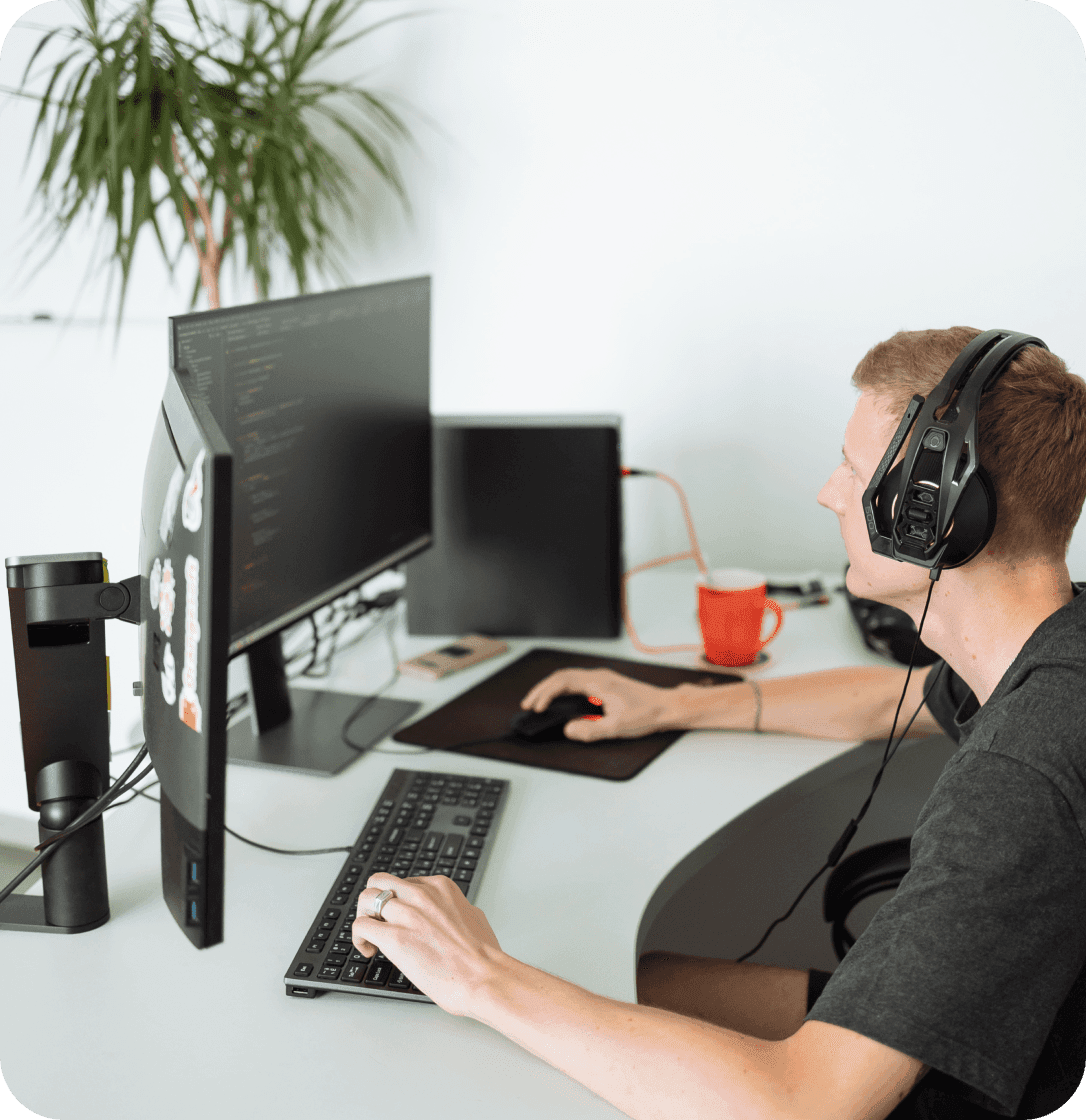
Our team has built regulated-environment software across clinical trials, diagnostics, life sciences, remote patient monitoring, and EHR integration for over 15 years.

Compliance-first development
HIPAA, CAP/CLIA, ISO 13485, and 21 CFR Part 11 get built into our development process, not added at the end, with built-in security measures to protect sensitive data and clear audit trails for compliance and reproducibility. We produce the documentation your validation team needs, when they need it.
Instrument integration experience
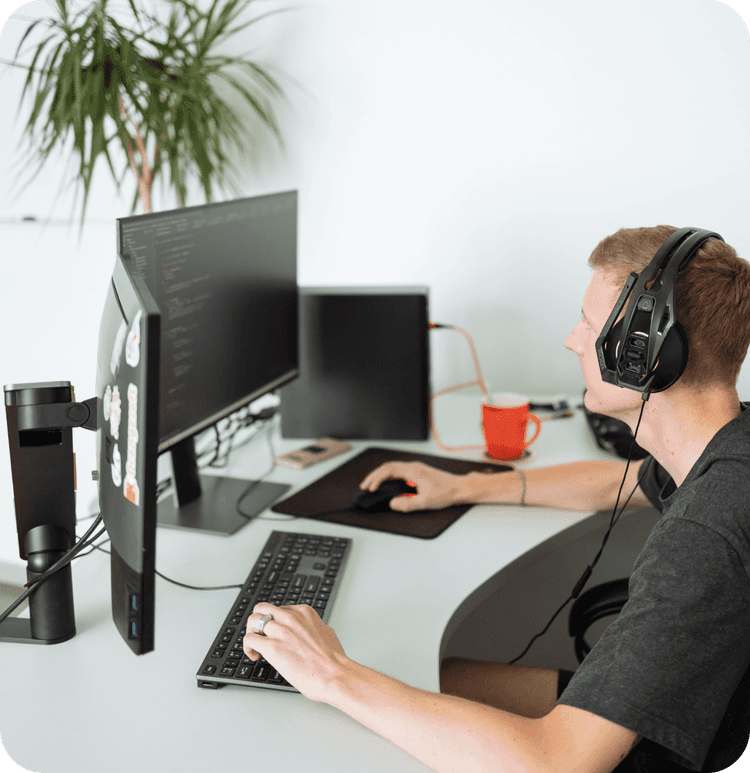
We build interfaces to lab analyzers using ASTM E1381/E1394, HL7 v2, FHIR R4, and proprietary instrument protocols. We don't learn these protocols on your project.

Long-term partnership
We don't hand off and disappear after launch. Post-launch support, QA, and system evolution are part of how we work, because a lab's compliance requirements and instrument fleet don't stop changing once the software ships.
Questions you might have
Schedule a free consultationHow much does custom laboratory software development cost?
Custom laboratory software typically starts at $80,000. Cost depends on scope: how many instrument integrations are involved, which compliance requirements apply, how much historical data needs to migrate, and how much validation documentation the project requires. A mid-complexity LIMS or LIS lands in the $150,000–$250,000 range; enterprise builds with multiple instrument integrations, data migration, and full validation documentation run $195,000–$350,000 and above. We confirm the number on a discovery call once we understand your instrument fleet and compliance environment.
What is the difference between LIMS and LIS?
A LIMS (Laboratory Information Management System) manages samples and workflows (accessioning, chain-of-custody, QC, storage, and disposal) and is common in pharma R&D, biobanks, and environmental or food-testing labs. A LIS (Laboratory Information System) manages the clinical order-to-result cycle for a diagnostic lab, including EHR communication via HL7 or FHIR. Some labs run both, connected, when they combine research and clinical reporting functions.
Do you build cloud-based LIMS (Laboratory Information Management System) or on-premise lab software?
Both. We architect for cloud infrastructure (AWS, Azure) when scalability and remote access matter most, and for on-premise or hybrid deployments when data residency or existing infrastructure investment requires it.
What compliance standards do you build for (CAP/CLIA, GLP, 21 CFR Part 11)?
We build to CAP/CLIA, GLP, and 21 CFR Part 11 requirements as part of the system architecture — audit trails, access controls, electronic signatures, and retention rules.
Can you integrate a custom LIMS with our existing EHR?
Yes. We build LIMS-to-EHR integrations using HL7 v2.x and FHIR R4, so results generated in the LIMS reach the clinical record without a manual re-entry step.
How long does LIMS or LIS development take?
Most custom LIMS/LIS builds take 6–18 months. A single module with minimal integrations can go live in 3–5 months. Enterprise or multi-site rollouts run 16–18 months and beyond.
How much does a Laboratory Information Management System (LIMS) cost?
A LIMS typically costs $150,000–$350,000+, depending on site count and GxP validation requirements. A single-laboratory LIMS covering samples, workflows, instruments, and reporting costs $150,000–$250,000+. An enterprise LIMS with multi-site GxP validation, an instrument fleet, and LIS/ERP integrations costs $195,000–$350,000+. Ranges are based on Orangesoft's delivery experience — contact us for a project-specific estimate.
How much does a Laboratory Information System (LIS) cost?
A LIS typically costs $150,000–$350,000+, depending on site count and EHR/billing integration scope. A clinical-core LIS covering orders, results, and quality control costs $150,000–$250,000+. An enterprise LIS with multi-site deployment, EHR/EMR and billing integration, and regulatory reporting costs $240,000–$350,000+. These figures reflect Orangesoft's past project experience — contact us for a quote tailored to your scope.
How much does an Electronic Lab Notebook (ELN) cost?
An ELN typically costs $80,000–$220,000+, depending on regulatory compliance requirements. A core ELN with experiments, templates, search, and electronic signatures costs $80,000–$140,000+. A regulated ELN with GxP and 21 CFR Part 11 compliance, review workflows, and LIMS/instrument integration costs $130,000–$220,000+. Actual cost depends on your specific requirements — contact Orangesoft for a precise estimate.
How much does a Clinical Data Management System (CDMS) cost?
A CDMS typically costs $95,000–$300,000+, depending on study volume and CDISC compliance requirements. A core CDMS covering data cleaning, queries, medical coding, and exports costs $95,000–$180,000+. A validated enterprise CDMS with multi-study support, CDISC standards, an audit trail, and integrations costs $150,000–$300,000+. Ranges are based on Orangesoft's delivery experience — contact us for a project-specific estimate.
How much does laboratory instrument integration cost?
Laboratory instrument integration typically costs $70,000–$200,000+, depending on the number of instrument types and whether control is bidirectional. Integration for a small set of instruments (drivers, parsing, data upload) costs $70,000–$120,000+. Middleware supporting many instrument types with bidirectional control and monitoring costs $115,000–$200,000+. Final pricing depends on your project's scope — contact Orangesoft to discuss your specific needs.
How much does laboratory billing software cost?
Laboratory billing software typically costs $80,000–$200,000+, depending on payer rule complexity and prior authorization needs. A billing module covering test pricing, claims, and invoices costs $80,000–$130,000+. A full revenue platform with payer rules, prior authorization, denial management, and LIS integration costs $125,000–$200,000+. These figures reflect Orangesoft's past project experience — contact us for a quote tailored to your scope.
- 1. Intro callDuring a 30-minute meeting, our experts dive into your lab type, existing systems, compliance environment, and project scope.
- 2. Free discovery workshopTogether with you, our technical team defines the architecture options and team composition.
- 3. Project planningWe provide the implementation plan, timelines, and estimations for your project.