AI-powered eczema app turns skin photos into trackable severity estimates
Industry
Services
Duration
Team involved
About the client
IQutis Labs builds AI-enabled products for chronic skin conditions, combining computer vision severity assessment, digital therapeutics, and skincare guidance.
The company works across atopic dermatitis and acne vulgaris. It owns the Atopic program, which pairs Atopic School, a free web-based curriculum that teaches patients and caregivers how to manage the condition, with the Atopic App.
Business challenge
Atopic School supported patients during a defined educational course, but that support ended when the course was completed. IQutis Labs needed a way to stay useful during the daily care that followed.
Atopic dermatitis affects an estimated 129 million people worldwide, with the heaviest burden in young children. About 60 percent of affected children show symptoms in their first year, 90 percent by age five, and 10 to 30 percent still have symptoms as adults. Managing atopic dermatitis requires consistent care, but maintaining a daily routine over time can be difficult.
Three goals shaped the product:
- Continuity: turning a finished curriculum into daily support.
- Better clinical conversations: replacing recollection with a documented history of triggers, symptoms, and treatment completion, which changes what clinicians have to work with.
- Engagement: bringing users back to educational material they had started and left.
None of it works if caregivers do not trust the numbers. A photo-based estimate had to be consistent and understandable enough for caregivers to track changes, while the guidance had to reflect each user’s recorded care plan without diagnosing the condition or changing treatment. IQutis Labs needed a partner who would build that boundary into the product itself.
Delivered solution
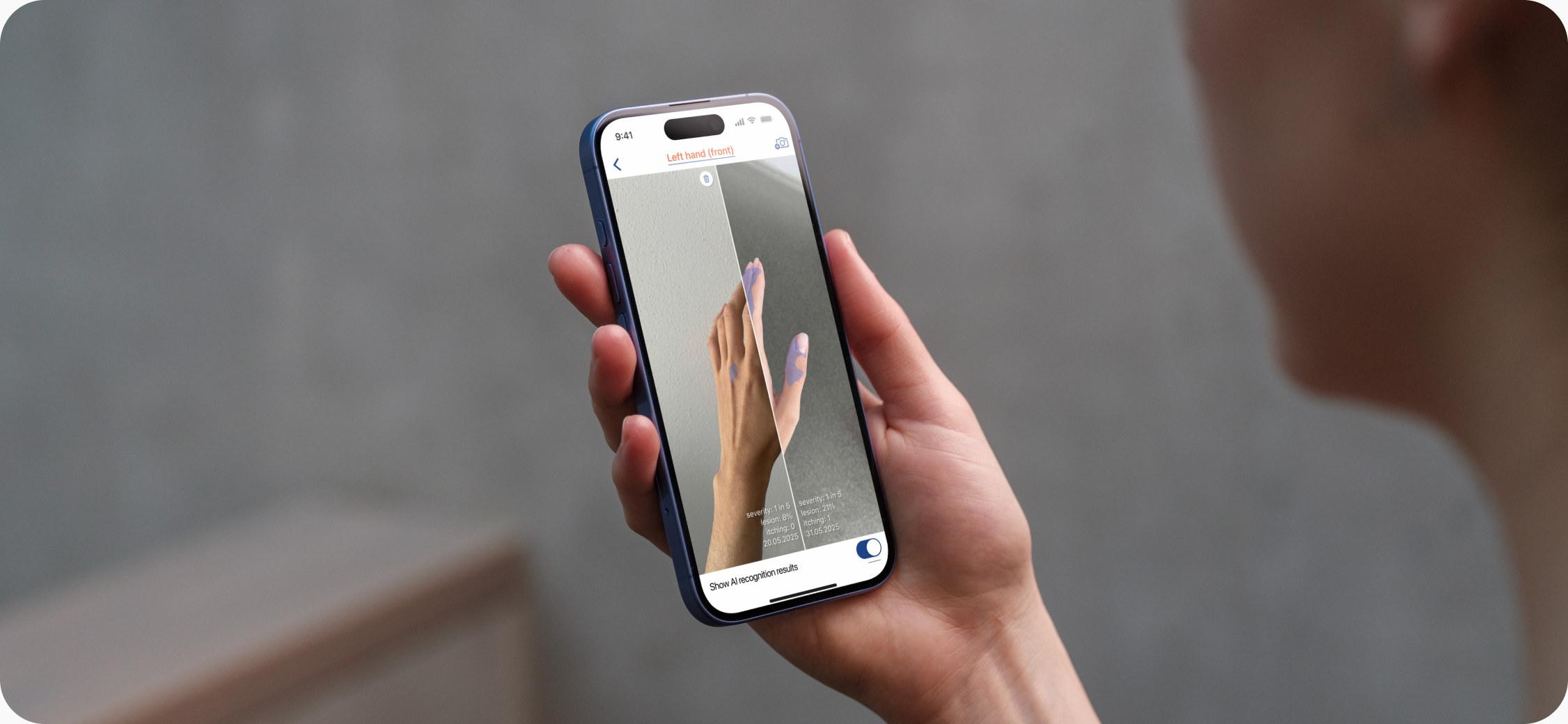
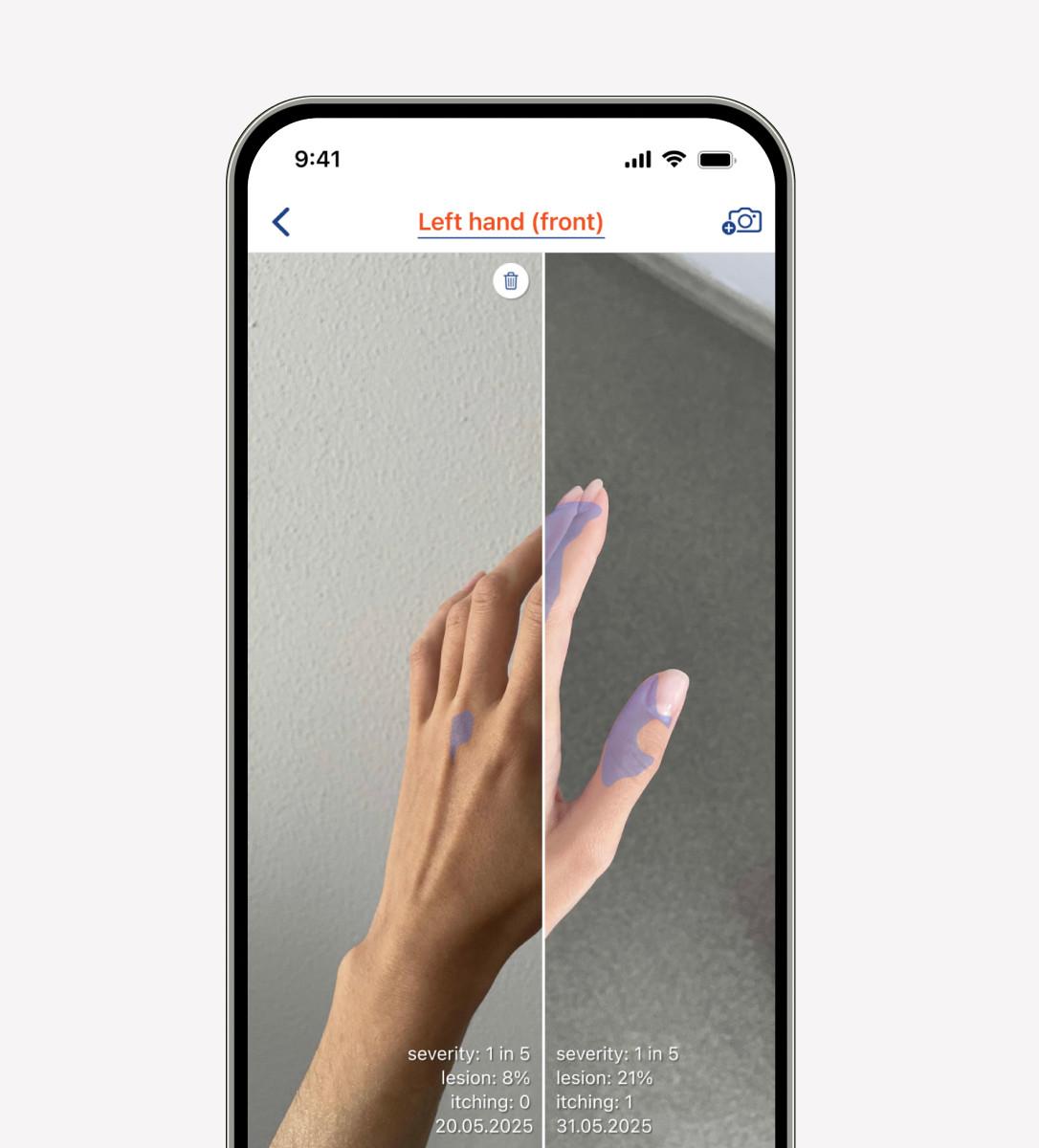
The HarDNet-based model separates skin from the surrounding image, identifies areas showing signs of atopic dermatitis, and evaluates four visible signs used in the EASI methodology: redness, thickening or papulation, excoriation, and lichenification. It reports the percentage of visible skin showing recognized signs of atopic dermatitis and a severity estimate limited to the photographed area. The result is not presented as a diagnosis or a clinician-administered whole-body EASI score.
The initial model was trained using more than 10,000 publicly available images of skin areas identified through condition-specific searches. Two certified dermatologists reviewed the images for clinical relevance and annotated the data used in the analysis. Because publicly sourced images vary in lighting, framing, quality, and representation, the model is used for longitudinal photo tracking rather than diagnostic decision-making.
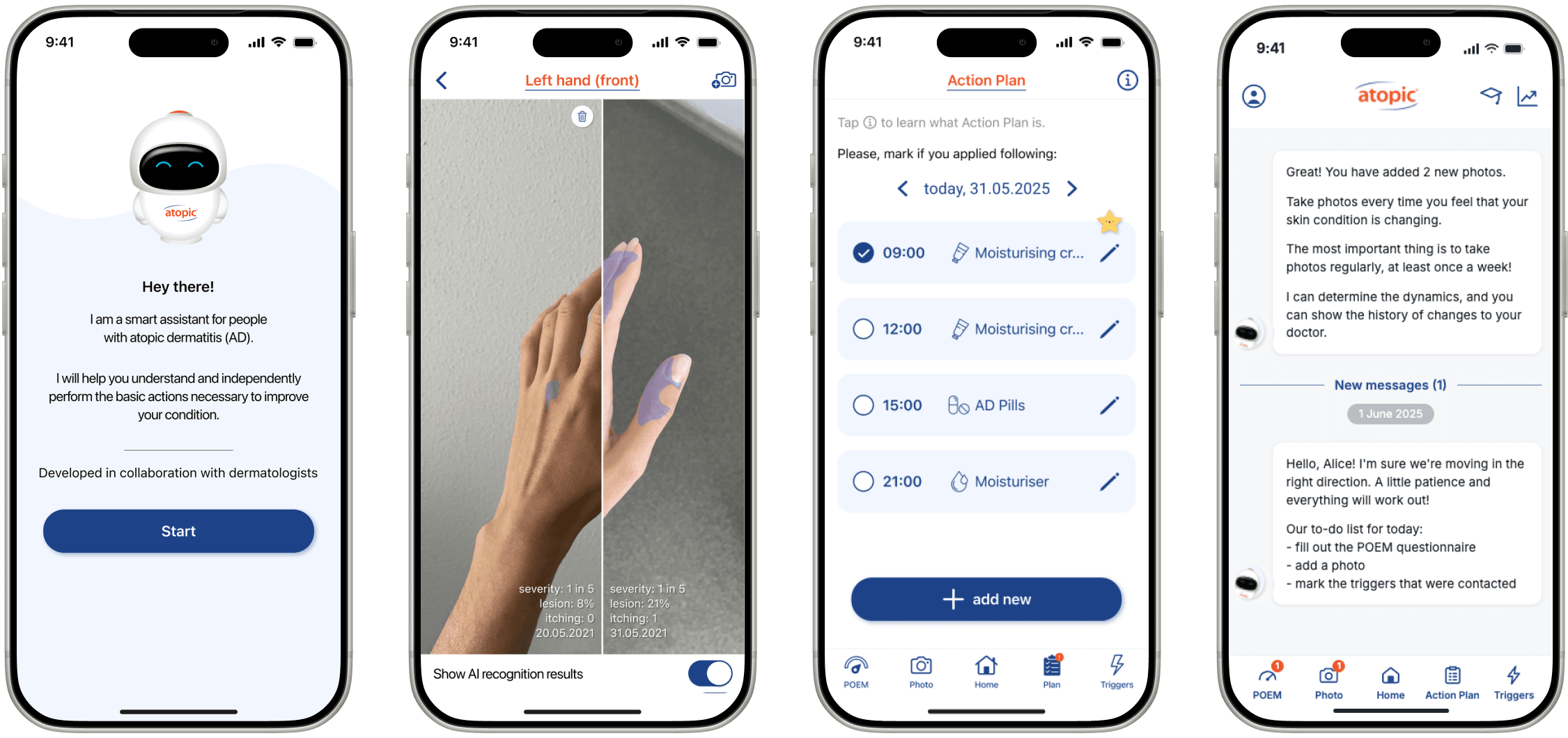
The computer-vision functionality sits within a broader care-support workflow. Users can compare photographs and estimates over time, record a clinician-prescribed care plan, schedule reminders, complete POEM questionnaires, and document suspected triggers. A guided assistant surfaces clinician-approved content and reconnects users with Atopic School, while the administrative tools support content, localization, and user management.
Key features
Photo tracking, a documented care routine, and clinician-approved guidance in one workflow designed for the time between clinical visits.
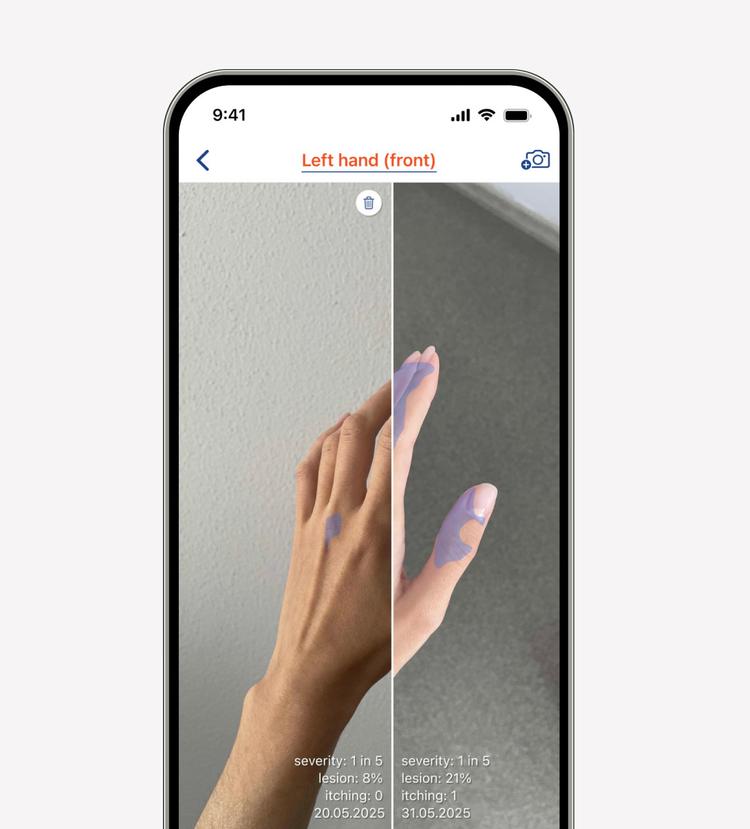
EASI-based severity estimate from a photo
The user photographs an affected area, and the app returns the percentage of skin involved and a severity reading across the four EASI signs, covering only the skin in frame and never presented as a diagnosis.
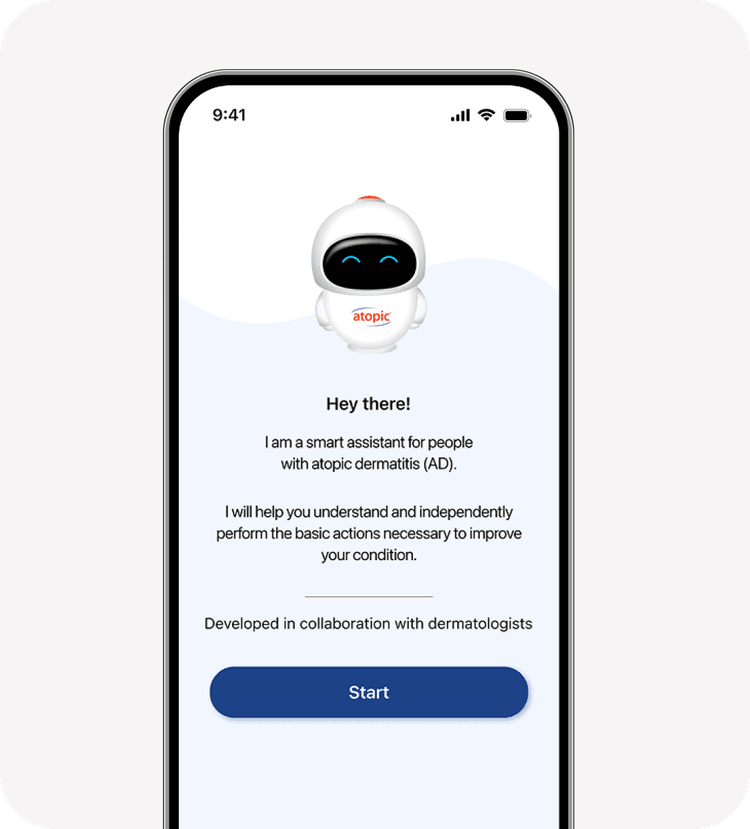
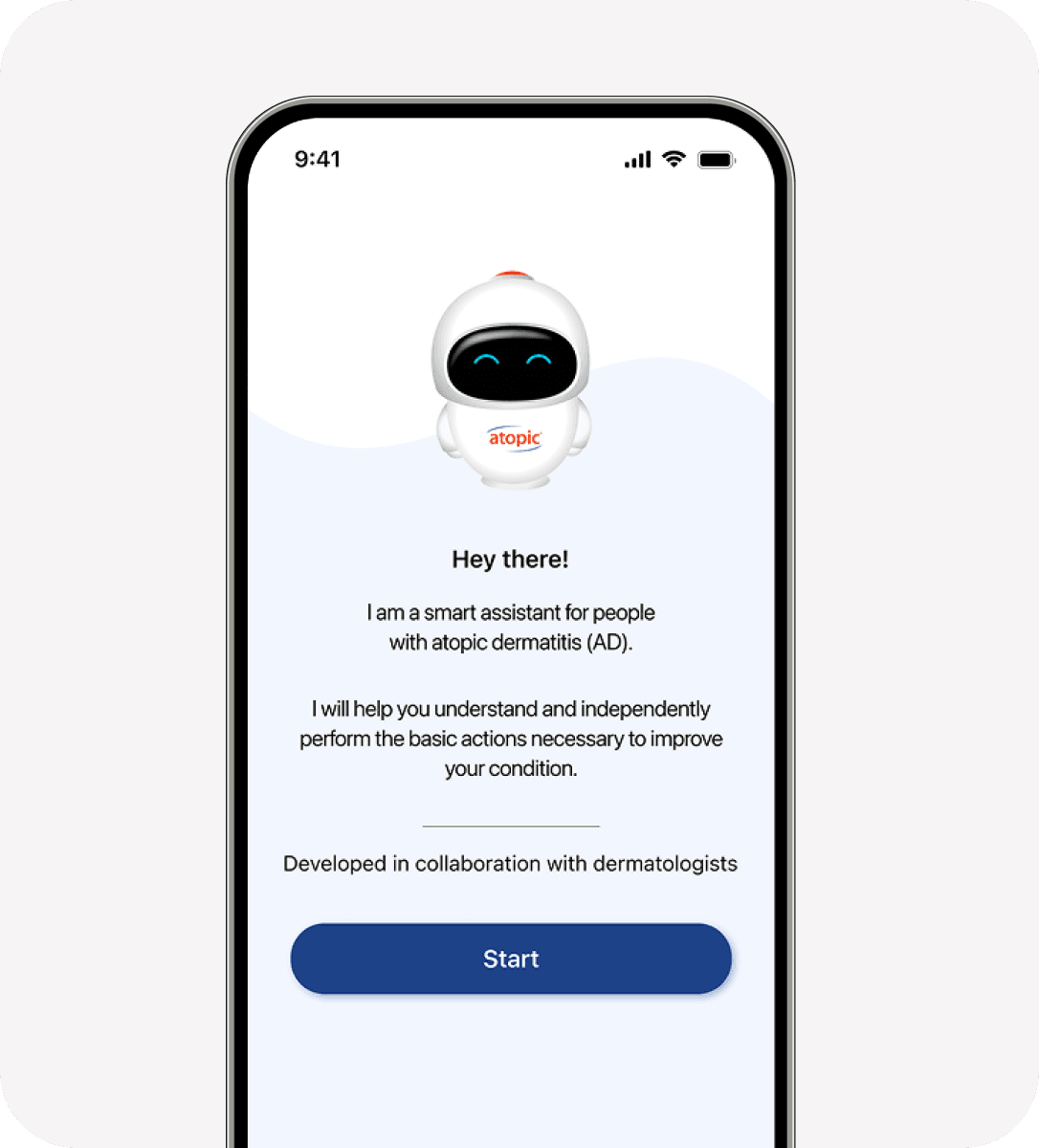
Guided support assistant
The assistant guides users through the product, explains recorded information in plain language, prompts the next step in their routine, and directs them to relevant Atopic School materials. All medical content is approved in advance by dermatologists and allergist-immunologists, and the assistant generates no medical advice of its own.
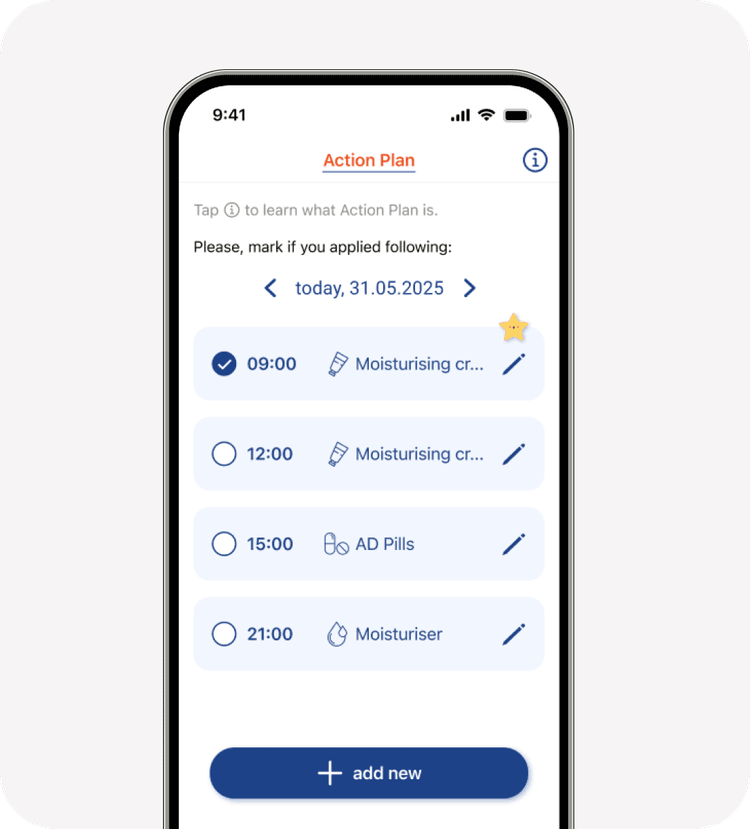
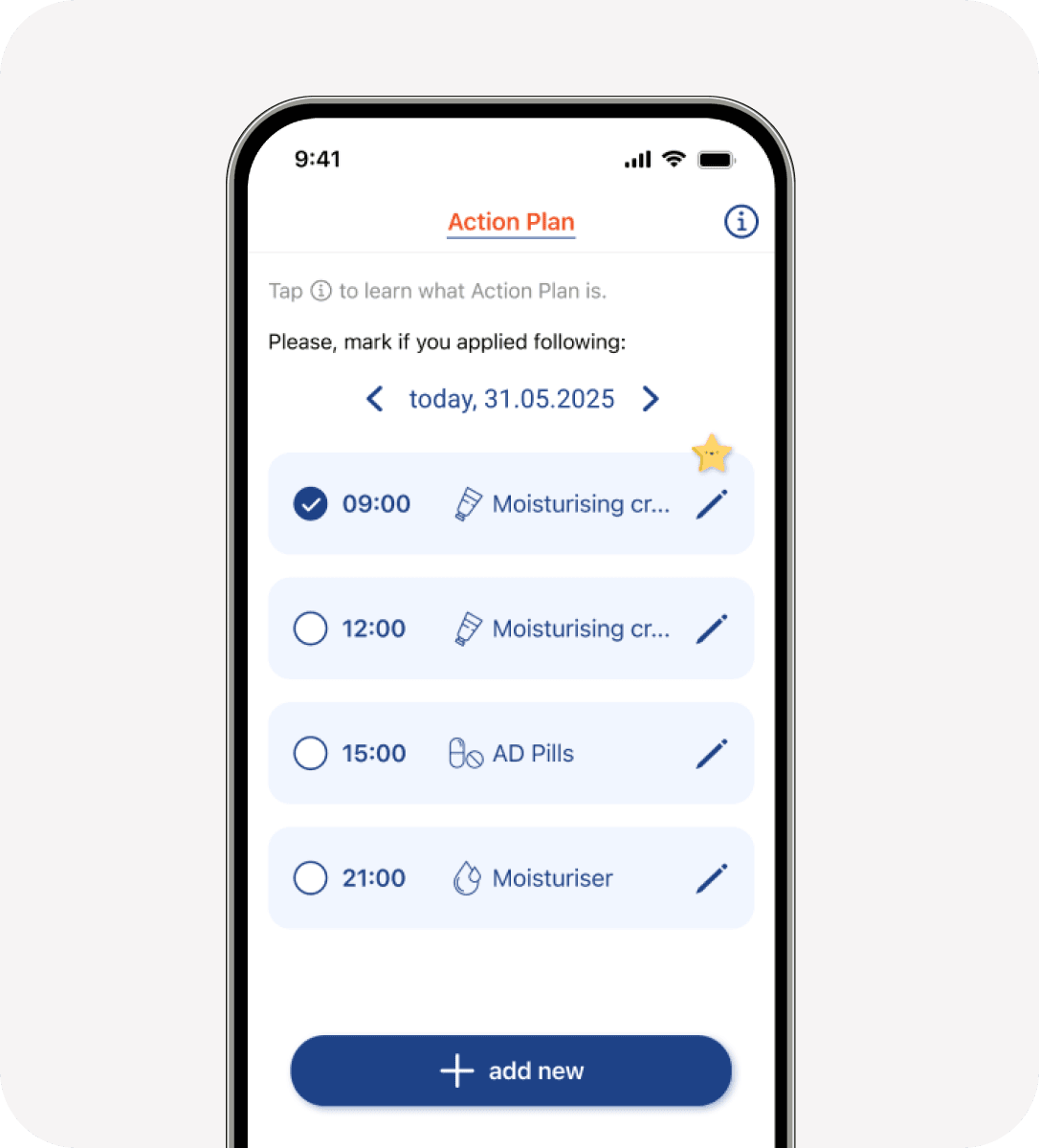
Action plan with scheduled reminders
Users record the care plan prescribed by their healthcare professional and turn it into a timed daily checklist, from morning moisturizer to evening medication. Notifications prompt each scheduled step, and the completed steps build an adherence history users can share with their clinician.
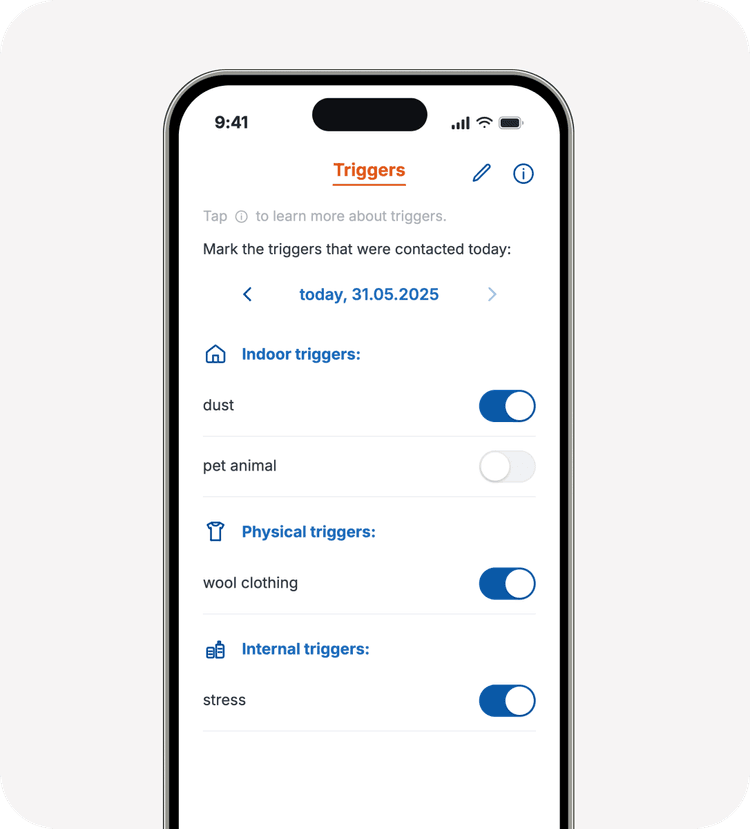
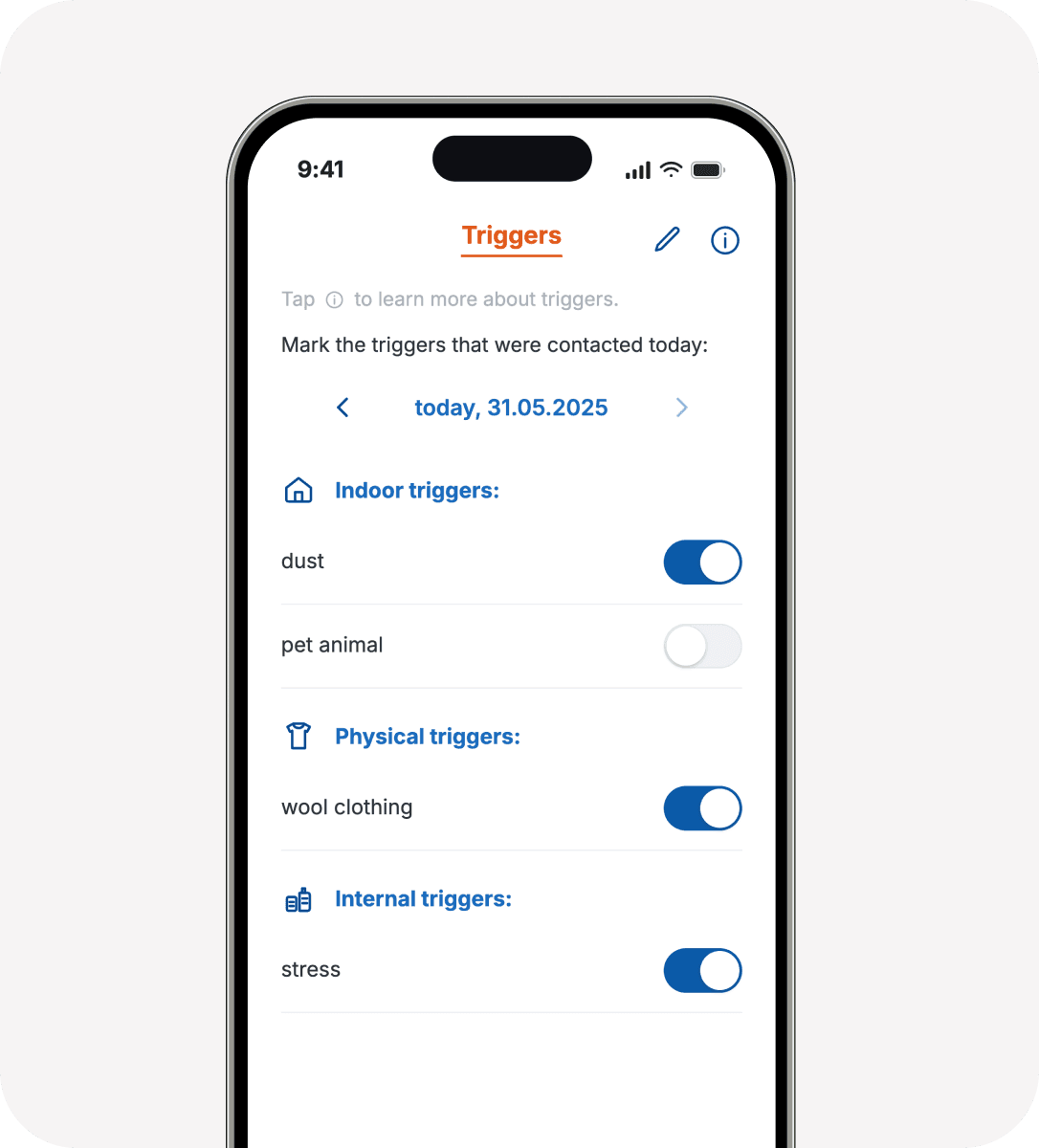
Trigger tracking
Users record suspected exposures and events alongside changes in their symptoms. Over time, this can help families notice recurring associations and prepare more specific questions for a healthcare professional, without the app determining that an exposure caused a flare.
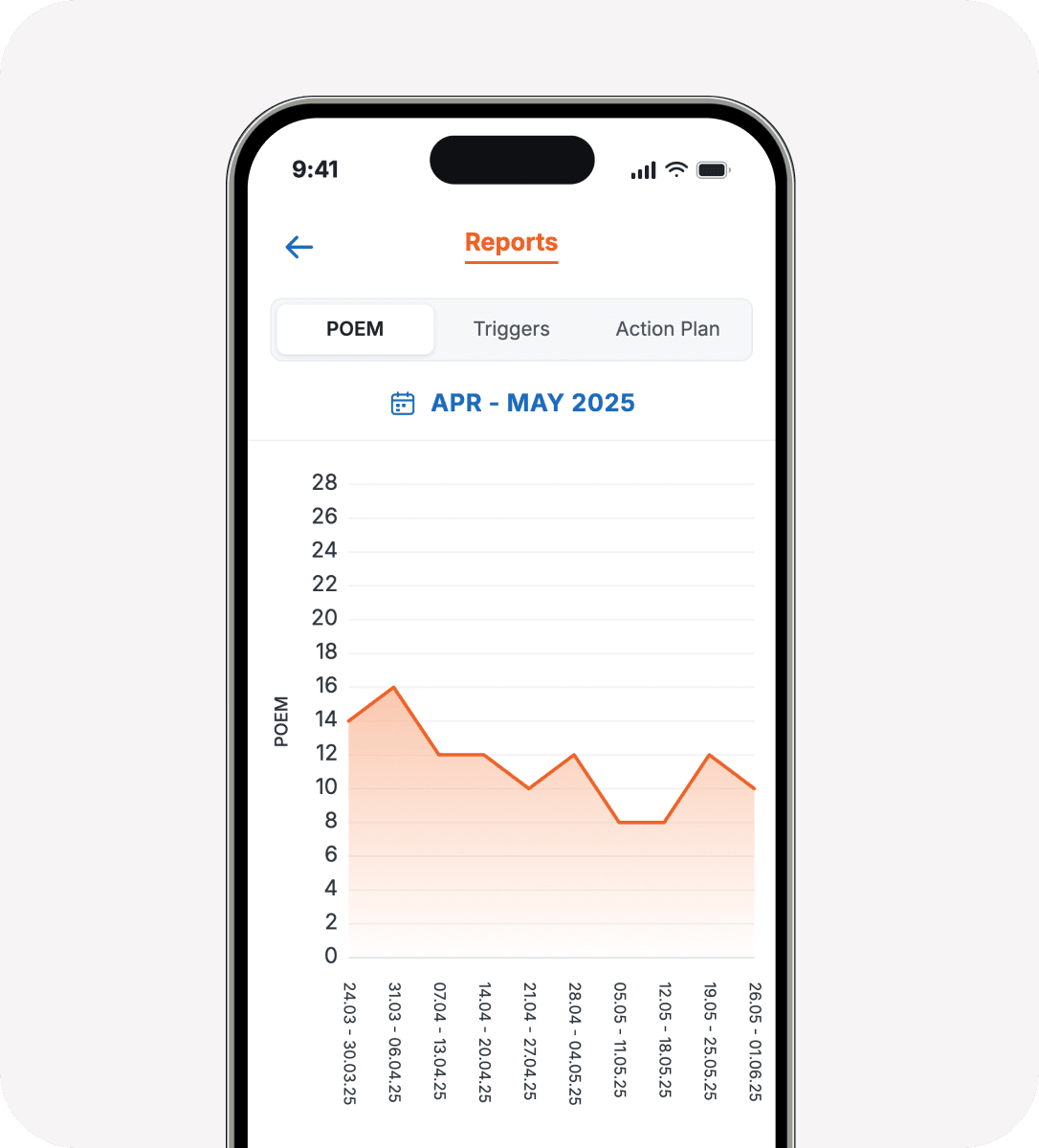
POEM questionnaire and reports
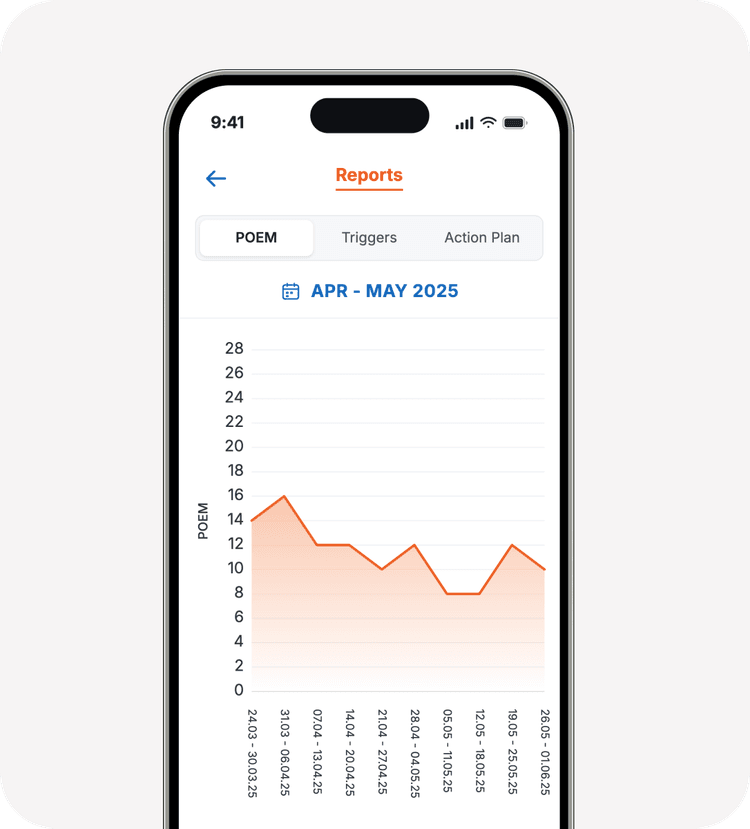
The app prompts patients or caregivers to complete POEM, the validated Patient-Oriented Eczema Measure, on a schedule. POEM history, photographs, suspected triggers, and Action Plan completion come together in a structured report users can bring to an appointment.
Translating a clinical framework into photo-based tracking
EASI was designed for a clinician examining a whole patient in person. A phone camera sees one patch of skin, at whatever distance and lighting the person uses.
The model handles this by scoring only the skin visible in the photo, which keeps each reading defensible and means the number is never presented as a whole-body EASI score. Users can compare photographs and local estimates of the same skin area over time.
A published study found a modest association between the AI-derived estimate and patient-reported POEM scores (r=0.35; P<.001). Because the two methods measure different aspects of the condition, that association should not be read as equivalence with a clinician’s assessment. Camera distance, lighting, and variability in patient-reported information were identified as possible sources of variation.
Personalizing support without generating medical advice
Guidance had to reflect an individual routine while every piece of medical content remained within material approved by clinicians. Personalization therefore lives in sequencing, timing, and prompting: the app selects which approved content to surface and when, and it generates no medical text of its own. The product-development research described in the published study included 20 in-depth interviews with dermatologists, allergists, adult patients, and parents.
Clinical safety boundaries
Atopic App supports self-monitoring and adherence to an existing care plan. It is not presented as an FDA-cleared medical device.
The product does not diagnose atopic dermatitis, recommend medication, or create or modify a treatment plan. Its computer-vision model produces an EASI-based estimate limited to the skin visible in a photograph; it does not generate a clinician-administered whole-body EASI score.
Care plans originate with the user’s healthcare professional. The app helps users record the prescribed routine, schedule its individual steps, and document what they completed. Medical content is approved in advance by dermatologists and allergist-immunologists, while the guided assistant selects and sequences that content without generating individual treatment recommendations.
Photographs, severity estimates, questionnaires, suspected-trigger records, and adherence history are combined to help users document changes and prepare for appointments. Diagnosis and treatment decisions remain with a qualified healthcare professional.
Data security and privacy
Skin photographs and health records are among the most sensitive information a consumer app can process, so data protection was built into the architecture from the start.

Regulatory compliance
Designed and delivered in line with GDPR, with data minimization and purpose limitation.

Encryption
Personal data is encrypted in transit and at rest, with keys held in Cloud KMS.

Access control
Sensitive records are pseudonymized, with access limited by role.

Security testing
The process includes vulnerability scanning and penetration testing.

Informed consent
Use of photographs to improve the model is disclosed and consented to separately.

User data rights
Users can access, export, correct, and delete their account and records.
Technology stack
Our team combined native mobile development, a Symfony backend, and a computer-vision pipeline that runs the severity model in production.
AI

Python

PyTorch

OpenCV

Albumentations

MLflow

DVC

Docker
iOS

Swift
SwiftUI

Moya

Core Data
Android

Kotlin

Jetpack Compose

Coroutines and Flow

Retrofit
Backend

PHP 8

Symfony

Doctrine ORM

PostgreSQL

Redis

RabbitMQ

Stimulus
Cloud & DevOps

Google Cloud Run
Cloud SQL
Cloud Storage
Cloud KMS

Firebase

Terraform

Bitrise

GitHub Actions
QA

Pytest

JUnit
Project results
Atopic App launched on iOS and Android in three languages, giving patients and caregivers one place to document skin changes, follow recorded care routines, and prepare information for appointments.
IQutis Labs reports that more than 10,000 people have used the Atopic App. The mobile products are supported by administrative tools for content and user management and remain free on the App Store and Google Play.
The product has also been examined in published research. A pilot randomized study involving 58 children found significant improvement in SCORAD and POEM scores across all study groups, while differences between the original randomized groups were not statistically significant.
In a secondary analysis by engagement, participants who used the app on at least eight days had a median clinician-assessed SCORAD score of 6.25 after about three months, compared with 17.9 among participants without the app and 13 among less-frequent users. Use on at least eight days also significantly predicted changes in SCORAD and POEM in the study’s regression models, and at the six-month assessment the differences between engagement groups were no longer statistically significant.
These findings provide preliminary evidence of an association between sustained app engagement and better disease-management outcomes; they do not establish that any individual feature caused the improvement. An earlier observational study also found a relationship between education and continued engagement: users who completed Atopic School used the app approximately twice as frequently as users who did not complete the course.
For IQutis Labs, the delivered product extended a time-limited educational program into an ongoing digital experience. For users, it brought photo documentation, symptom history, suspected triggers, care-plan completion, and educational support into one workflow designed for the time between clinical visits.


Kickstart your digital journey today!
Add your brand's success story to our global list of disruptive brands.
Join the clubWe're trusted by:
- 1. Intro callDuring a 30-minute meeting, our domain expert dives into your business and describes the steps for future collaboration.
- 2. Free discovery workshopTogether with you, our technical team defines the user flow, feature list, and project risks.
- 3. Project planningWe provide the implementation plan, timelines and estimations for your project.