Meet our CEO →
Healthcare Financial Software Development Services
We design and build custom software for medical billing, revenue cycle, claims processing, prior authorization, and payments. Each system is tailored to your payer rules and connects to the EHR, clearinghouse, and payer systems you already run, to bring down denials and A/R days.
Book a scoping call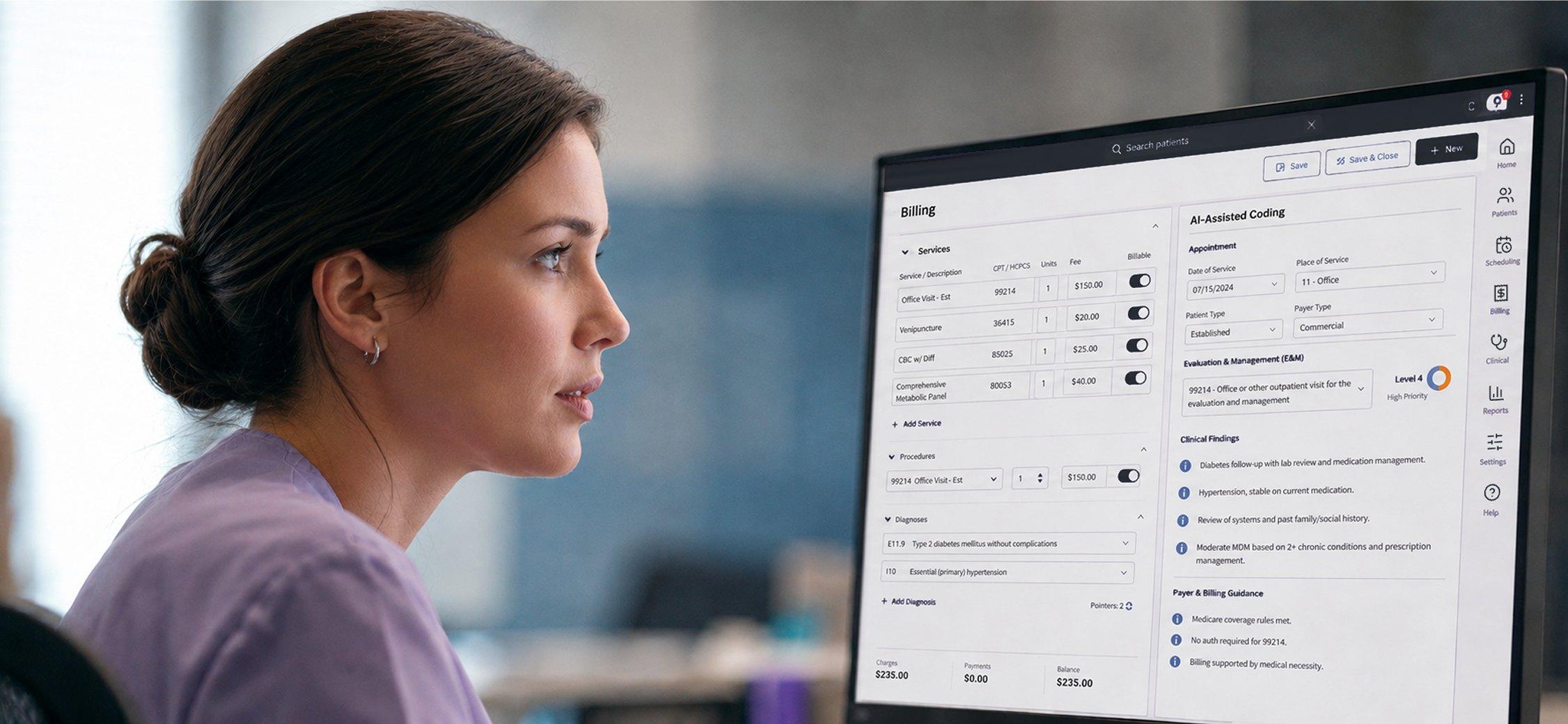
Financial software that fits your payer mix and your EHR
With 15 years in healthcare and fintech, we help billing companies, health systems, payers, and healthtech teams get financial software that follows their payer rules and works with their EHR, so fewer claims get denied and payments arrive sooner. Off-the-shelf platforms cover the standard revenue cycle well, but when payer contracts, the EHR environment, or claim volume don't fit the standard case, a custom build pays off.
Healthcare financial software development services
From a single billing module to a full revenue cycle platform, designed around your payer rules and connected to the systems you already run.
Book a scoping call
Custom financial software development
We build billing, RCM, claims, prior authorization, and payment systems from requirements to production, around your payer rules and workflows.

Modernization of legacy billing and RCM systems
We replace or extend a billing or RCM system in phases and run the old and new systems in parallel through cutover, so claims keep flowing.

Integration with EHRs, clearinghouses, and payers
We connect financial systems to Epic, Oracle Health, athenahealth, and other EHRs with read or write-back access, and to clearinghouses and payers.

Product development consulting
We help teams decide what to build and what to buy, scope compliance, and plan the integration sequence before development starts.
Healthcare financial software we build

Medical billing software
We build billing systems for physician groups, hospital networks, and billing service organizations that get clean claims to payers on the first pass and show where unpaid revenue is stuck, with fee schedules and payer rules set per practice.
Explore more
Revenue cycle management software
We build RCM platforms that follow a patient account from registration to collections, as one platform or as separate modules, so A/R days and denial rates are measured across the whole cycle rather than one department at a time.
Explore more
Insurance claims processing software
We build adjudication engines and claims workflows for payers, TPAs, and insurtech teams, with coverage rules and contract terms that operations staff can update without waiting for a release.

Prior authorization software
We build prior authorization software for both sides: provider workflows that request approval when the order is placed, before a claim can be denied, and payer APIs that meet federal requirements.

Healthcare payment processing
We build payment flows for patients and payers, connected to the EHR and the A/R ledger, so the balance a patient pays matches the claim and the payer remittance.

Patient financing and medical loan software
We build point-of-care financing for patients who cannot pay a full balance at once, connected to lenders, with rules that decide which patients see an offer and when.
Who needs custom healthcare financial software
We build healthcare fintech solutions for every side of the money flow, from providers and payers to patients.
Medical billing companies and RCM vendors
Custom billing engines, denial management tools, A/R workflow automation
Hospital systems and health networks
EHR-integrated billing, RCM platforms, patient payment portals
Health insurance companies and payers
Claims processing automation, adjudication engines, prior authorization systems
Digital health and telehealth platforms
Payment processing, HSA/FSA integration, subscription billing
Ambulatory surgery and specialty care centers
Charge capture, patient financing, prior authorization workflows
Healthtech startups
Billing, RCM, or payment modules built into your own product, from MVP to scale
What medical billing software actually costs
The first release of a billing platform that raised an outpatient billing company's valuation in an M&A deal, with its scope, team and budget.
A claims and patient billing platform serving 40+ outpatient practices
- Budget, first release
- $214,040
- Timeline, first release
- 6 months
- Outpatient practices
- 40+
Team
2 backend developers, 1 frontend developer, 1 integration engineer (X12/EDI), 1 QA engineer, 1 business analyst, 1 project manager, plus a part-time certified medical coder.
These are indicative figures based on Orangesoft's delivery experience, not a commercial offer. A binding estimate is produced after a discovery phase.
Request free estimateDelivered solution
- Multi-practice setupSeparate NPI/TIN, fee schedules and payer rules per practice, tracking of payer, EDI, ERA and EFT enrollment
- Charge capture and codingCPT, HCPCS and ICD-10-CM with modifiers, coder worklists
- ClaimsScrubber with NCCI PTP and MUE edits, LCD/NCD medical necessity checks and payer-specific rules, professional claims (837P) for the client's top payers via a clearinghouse, secondary claims and coordination of benefits
- Payments and denialsAutomatic posting of payer remittances (835/ERA), denial worklists with reason codes and appeal templates
- Patient billingStatements, online payment, payment plans, Good Faith Estimates for uninsured and self-pay patients, pay-over-time offers through a patient financing partner
- ReportingA/R aging, days in A/R, clean claim rate, first-pass resolution rate, denial rate by payer and reason, net collection rate
- Compliance and securityHIPAA handling, PCI DSS scope kept minimal via a tokenized payment provider, SOC 2-ready controls, audit logging
HIPAA compliance and healthcare regulatory standards
We build to the HIPAA Security Rule technical safeguards for any system that stores or transmits billing or payment data tied to a patient record, and to the HIPAA Breach Notification Rule added by HITECH. Where a system handles card transactions, PCI DSS applies alongside HIPAA. We use HL7 FHIR R4 for clinical data and X12 EDI 5010 for claims and eligibility, so data stays portable between systems. For provider clients and certified health IT developers, we also account for the ONC information blocking rules (45 CFR Part 171) in how patient billing and payment data is accessed and shared.
We keep the signed BAA, security risk assessment, and PCI documentation organized for your compliance team, and map which vendors in the data path need a BAA.
Orangesoft holds ISO 9001:2015 certification for quality management and signs a HIPAA Business Associate Agreement as standard for healthcare engagements that touch protected health information.
Standards and regulations we build for
We design each system to the regulations that govern health and payment data and to the interoperability standards your payers and EHRs expect.

HIPAA

HITECH
PCI DSS
HL7 FHIR
X12
Healthcare financial software development process at Orangesoft
We build financial systems in stages, with your billing or RCM team involved from discovery to cutover. Integrations and compliance scope are settled before development starts, so the claims flow never stops during a switch from an existing system.
Product discovery
We map the payer mix, existing systems, clearinghouse and EHR connections, and compliance requirements, and we find where the current process loses time or revenue.
Development planning
We sequence integrations, define the claims data model, and set the audit trail, access, and retention rules before development starts.
MVP design and development
We build in sprints with your billing or RCM team in every demo. Compliance validation against HIPAA, PCI DSS, and payer requirements runs inside this stage, and where an existing system is being replaced, the old and new systems run in parallel before cutover.
Launch and post-launch support
Once your system goes live, we support the cutover, monitor claim flow and integrations, and track clean claim rate, denial rate, and days in A/R. As payers change their rules, fee schedules, and transaction requirements, we update the system and keep it in line with HIPAA and PCI DSS requirements.
Scaling
We plan new releases around your billing team's feedback and business goals, adding payers, sites, and modules. As claim volume grows, we optimize the architecture, databases, and integrations so the system keeps pace with demand, and keep the rules engine current.
Challenges we solve in healthcare financial software
Healthcare finance sits between payers, EHRs, and compliance rules that each change on their own schedule. These are the problems we see most often, and how we handle them.
Book a scoping call
Payer rules change faster than releases
Payer-specific edits, fee schedules, and coverage rules change constantly. We build them as configuration an operations team can update, with a staging check against historical claims before a change goes live.

Legacy billing with no usable API
Older billing and RCM systems often block EHR integration and reporting. We extend or migrate them in phases and run both systems in parallel through cutover.

Health data and card data in one system
PHI and cardholder data fall under different rules. We keep them in separate, scoped components and log every transaction that touches a patient record.

Claims data scattered across systems
Charges sit in the EHR, claims at the clearinghouse, remittances at the payer. We build reconciliation that ties each payment to the claim it settles, so finance works from one ledger.
Our clients say it better





Why teams build healthcare financial software with Orangesoft
A team that knows payer rules, X12 transactions, and HIPAA as well as it knows code.




Compliance in the architecture
Audit trails, role-based access, and separate scopes for PHI and card data are designed in at the architecture stage. We sign a BAA as standard for healthcare engagements that touch protected health information.

Named standards
We build to X12 EDI 5010 (837P, 837I, 835, 270/271, 276/277), HL7 FHIR R4, HL7 v2, and CDS Hooks. In discovery, we state what each connected system exposes before we plan the build.

A cost range before the call
Typical budget ranges and a real project budget are published on this page, so you can check budget fit before you contact us. A binding estimate follows a scoping session.
Questions you might have
Schedule a free consultationWhat is healthcare financial software?
Healthcare financial software covers systems that manage the money flows in healthcare: billing, claims, revenue cycle, prior authorization, payment processing, and patient financing. Custom healthcare financial software is built around a specific payer mix, EHR environment, and workflow, instead of adapting a generic accounting or SaaS billing tool.
Should we build custom financial software for healthcare or buy an existing platform?
Buy when your payer mix, EHR, and volume fit what a platform such as Waystar, athenahealth, or NextGen already does. Build when payer rules, EHR environment, or claim volume do not fit, or when the financial module is part of your own product. Many projects mix both: we connect to an existing clearinghouse and build only the workflow that no product covers.
How much does custom healthcare financial software cost?
Projects typically range from $70,000 to $400,000+, depending on the type of system. The final figure depends on the number of payers and EHR integrations, claim volume, and compliance scope. We give an estimate after a scoping session.
What is patient financing software?
Patient financing software manages payment plans and medical loans offered at the point of care. It handles loan origination, repayment scheduling, integration with lending partners, and collection workflows for defaults. Providers use it to reduce bad debt on high-deductible accounts.
How much does patient financing software cost?
An application flow with scoring integration and lender handoff costs $80,000 to $140,000+. A full platform with underwriting, servicing, a provider portal, and compliance reporting costs $120,000 to $250,000+.
How much does insurance claims processing software cost?
A core system for intake, validation, and adjudication support costs $100,000 to $180,000+. An enterprise platform with a payer rules engine, fraud checks, appeals, and integrations costs $170,000 to $300,000+.
How much does prior authorization software cost?
A request tool with forms, payer routing, and status tracking costs $80,000 to $140,000+. An automated platform with a payer rules library, document assembly, AI extraction, and EHR/EMR integration costs $130,000 to $250,000+.
How much does healthcare payment processing software cost?
A patient payments module with payment provider integration, statements, and receipts costs $70,000 to $120,000+. A full platform with payment plans, cost estimates, refunds, multi-entity reconciliation, and compliance costs $115,000 to $230,000+.
Can you integrate with Epic, Oracle Health, or other EHR systems?
Yes. We integrate billing and RCM systems with Epic through Epic on FHIR (FHIR R4 with SMART on FHIR authorization), with Oracle Health through its FHIR R4 APIs for Millennium, and with athenahealth through its FHIR R4 APIs and the athenaOne APIs available to Marketplace partners. For MEDITECH Expanse and other EHRs, we agree the integration path with the vendor and the client in discovery, for example HL7 v2 feeds such as ADT and DFT. We confirm in discovery what each vendor exposes, read access or write-back, because it changes the design. Vendor-by-vendor detail is on our EHR integration services page.
What compliance standards apply to healthcare payment software?
HIPAA for protected health information in payment records, PCI DSS for card transactions, and the HIPAA Breach Notification Rule (required by the HITECH Act) for breach notification. For provider clients and certified health IT developers, the ONC information blocking rules (45 CFR Part 171) also apply to how patient billing and payment data is accessed and shared. We document all data flows and sign a HIPAA Business Associate Agreement as standard for healthcare engagements that touch protected health information.
- 1. Intro callDuring a 30-minute meeting, our domain expert dives into your business and describes the steps for future collaboration.
- 2. Free discovery workshopTogether with you, our technical team defines the user flow, feature list, and project risks.
- 3. Project planningWe provide the implementation plan, timelines and estimations for your project.