Prior Authorization Software Development Services
Orangesoft develops custom prior authorization software for providers, billing companies, and health plans. It checks whether a service needs approval, assembles the request from EHR data, sends it to the payer, and tracks the decision. Each system connects to your EHR and payers and is built to meet HIPAA requirements.
Book a scoping call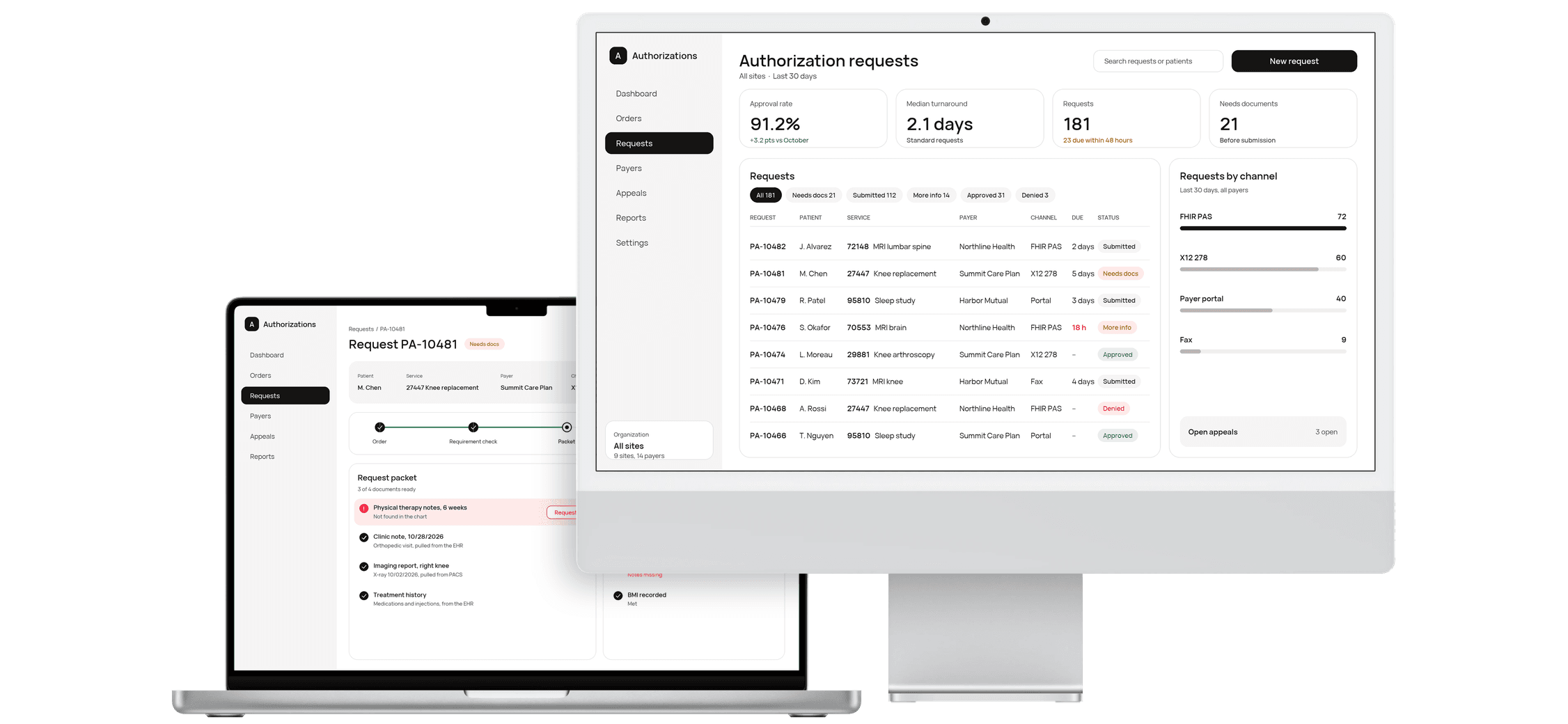
Prior authorization software that sends complete requests on the first try
Orangesoft builds electronic prior authorization software that starts the request when a service is ordered. The system checks the payer's rules, pulls the clinical documentation from the EHR, submits the request, and marks the order as pending authorization until a decision comes back.
Most delays come from a few points. Staff do not know that a service needs approval, the request goes out without the documents the payer asks for, or nobody follows up on a pended request before the appointment. We close those gaps with payer rules your team can update, request packets filled in from the chart, and worklists that show every open request with its deadline.
Why prior authorization takes so much of the week
Prior authorization software development services we offer
Our prior authorization software development covers a single request workflow for one specialty as well as a platform that serves every site and payer you work with.
Book a scoping call
Custom prior authorization software development
We design and build prior authorization software around your payers, specialties, and ordering workflows, as a standalone tool or as a module of your billing or RCM system.

Prior authorization API development for payers
We build the FHIR Prior Authorization API that CMS-0057-F requires of impacted payers, along with intake, review worklists, and decision notices on the payer side.

EHR and payer integration
We connect prior authorization software to your EHR, practice management system, clearinghouse, and payer channels, and confirm with each EHR vendor whether we can only read data or also write it back.

Prior authorization consulting
We map how requests move through your organization today, find where they stall, and scope the first release in a product discovery phase before development starts.
Prior authorization software we deliver

Authorization requirement checks
We build rules that tell staff at the moment of ordering whether the payer requires prior authorization for the service, so fewer requests are missed and fewer unnecessary ones are sent.

Request assembly from EHR data
We build request packets that fill in patient, order, and clinical data from the chart and list the documents each payer asks for, so staff review a prepared request instead of typing it.

Submission and status tracking
We build submission through the channel each payer accepts and keep the status, reference number, and deadline on every request until the payer decides.

Denials and appeals
We build worklists for denied and pended requests that show the payer's reason, route the case to the person who can respond, and track the appeal to its outcome.

Payer-side prior authorization systems
We build intake, clinical review worklists, and decision notices for health plans and TPAs, with a clock on every request so staff see which ones are close to the deadline.

Prior authorization analytics
We build dashboards that show approval rates, turnaround times, and denial reasons by payer and service, so you can see which requests need a different process.
AI use cases we build into prior authorization software

Prior authorization request drafts from clinical notes
Clinical data extraction from charts and faxed documents
Matching of chart evidence to payer criteria, reviewed by staff
Appeal letter drafts for denied requests
Prediction of requests likely to be denied or pended
Prior authorization standards and rules we build to
Prior authorization runs on federal rules, HIPAA transactions, and FHIR implementation guides. These are the ones we build against.
HIPAA
Privacy, Security, and Breach Notification Rules, applied through access control, audit logs, encryption, and BAAs.
CMS-0057-F
Payer decision timeframes, denial reasons, public metrics, and the FHIR Prior Authorization API for impacted payers.
X12 278
The HIPAA transaction for authorization requests and responses, version 5010.
HL7 FHIR and Da Vinci
FHIR R4 with the Da Vinci CRD, DTR, and PAS implementation guides for prior authorization.
CDS Hooks and SMART on FHIR
Requirement checks and documentation forms inside the clinician's EHR workflow.
NCPDP SCRIPT
Electronic prior authorization for prescription drugs.
Who needs custom prior authorization software
We build prior authorization software for organizations whose request volume, payer mix, or product needs go beyond what payer portals and packaged tools cover.
Hospital networks and health systems
One request workflow across sites and service lines, connected to each site's EHR
Specialty practices and imaging centers
Requirement checks and request packets tuned to high-volume services such as imaging, infusion, and surgery
Billing companies and RCM vendors
Prior authorization as a service line for client practices, with rules and reports kept per client
Health plans and TPAs
Request intake, review worklists, decision notices, and the Prior Authorization API
Digital health and telehealth platforms
Authorization checks built into ordering and referral workflows inside the product
Healthtech startups
A first release of a prior authorization product, ready for the first customers
Systems we integrate prior authorization software with
We build the integrations your prior authorization software needs with any system. Here are some of the systems we connect to.
EHR and EMR systems
Epic
Oracle Health
athenahealth
NextGen
eClinicalWorks
MEDITECH Expanse
Veradigm
Practice Fusion
Practice management systems
Tebra
AdvancedMD
DrChrono
CareCloud
Clearinghouses and payer networks
Availity
Waystar
Optum (Change Healthcare)
TriZetto
Stedi
Integration engines and cloud
Mirth Connect
Rhapsody
Redox
AWS
Google Cloud
Azure
Prior authorization software development process at Orangesoft
Challenges we plan for in prior authorization systems
Most prior authorization projects run into the same four problems: payer rules, submission channels, clinical documentation, and EHR access.
Book a scoping call
Payer rules that keep changing
Each payer decides which services need approval and changes that list on its own schedule. Rules live as configuration your team can update, and each change is tested on past requests before it reaches production.

A different channel for every payer
One payer accepts X12 278, another a portal, a third still asks for a fax. We build one worklist for staff and route each request to the channel its payer accepts.

Clinical documentation spread across the chart
The evidence a payer asks for sits in notes, results, and scanned documents. We pull it into one request packet and flag what is missing before the request goes out.

Read-only EHR connections
Some EHRs share data for reading only. Where a decision cannot be written back to the chart, we keep it on the request and show it to staff where they work.
Our clients say it better






Why choose Orangesoft as your prior authorization software development company
A team that knows payer rules, FHIR, and HIPAA as well as it knows code.




Healthcare software expertise
We've spent over 15 years building healthcare software, from patient-facing apps to EHR integrations, and bring that experience to every prior authorization project.

EHR and payer integrations
We connect prior authorization software to Epic, Oracle Health, athenahealth, and other EHRs, and to payers through X12 and FHIR, so requests are built from chart data and decisions return to the staff who need them.
Compliance built into the architecture
Audit logging, role-based access, and encryption are designed in from the first sprint. We sign a HIPAA Business Associate Agreement for every engagement that touches PHI.

Open cost benchmarks
We publish typical development costs for 100+ healthcare software solutions, prior authorization software included, in our Healthcare Software Development Cost Benchmark, so you can check budget fit before the first call. A binding estimate follows a discovery phase.
Questions you might have
Schedule a free consultationWhat is prior authorization software?
Prior authorization software manages a payer's approval of a service before it is delivered. It checks whether the service needs approval, assembles the request with the clinical documentation, submits it to the payer, and tracks the decision. Providers use it to send requests, and health plans use it to receive and review them.
Should we build custom prior authorization software or buy a platform?
Buy a platform when your payers and services fit what it supports and your staff can work the way the product expects. Build custom software when your services or payer mix need rules the product cannot hold, when prior authorization must run inside your own product, or when you are a payer with your own review process. You can also start with one custom module, such as requirement checks, and keep the rest of your current tools.
How much does prior authorization software development cost in 2026?
Plan $80,000 to $140,000+ for a request tool with forms, payer routing, and status tracking. An automated platform with a payer rules library, document assembly, AI extraction, and EHR integration costs $130,000 to $250,000+. Payer count, EHR connections, and the services in the first release set where a project lands. These are indicative figures based on Orangesoft's delivery experience, and a binding estimate follows a discovery phase. See how prior authorization compares with other systems in our healthcare software cost benchmark.
How long does it take to build prior authorization software?
Product discovery takes 2 to 3 weeks and development planning 3 to 5 days. A first release takes 2 to 6 months, depending on the number of payers, EHR connections, and services covered.
What does CMS-0057-F require for prior authorization?
CMS-0057-F is the CMS Interoperability and Prior Authorization Final Rule. Since January 1, 2026, impacted payers must decide standard requests within 7 calendar days and expedited requests within 72 hours, give a specific reason for each denial, and publish prior authorization metrics. From January 1, 2027, they must also offer a FHIR Prior Authorization API. The rule covers Medicare Advantage organizations, Medicaid and CHIP programs, and qualified health plan issuers on the federally facilitated exchanges, and it excludes drugs. The decision timeframes do not apply to those exchange plans.
Which standards does prior authorization software use?
Authorization requests travel as X12 278 transactions, the HIPAA standard, or through a payer's FHIR Prior Authorization API. The Da Vinci implementation guides cover the three steps of the FHIR workflow. CRD checks whether approval is required, DTR collects the documentation, and PAS submits the request. Many payers still take requests only through portals or fax, so the software has to support those channels too.
When does NCPDP SCRIPT version 2023011 become mandatory for drug prior authorization?
NCPDP SCRIPT is the standard for electronic prescriptions and related transactions, including electronic prior authorization for drugs. Under the CMS final rule on Medicare Part D e-prescribing, version 2023011 becomes the only permitted version on January 1, 2028. Until December 31, 2027, organizations may use either 2023011 or the older version 2017071. Software built for drug requests has to support 2023011 by that date.
Can prior authorization software work inside our EHR?
Yes. Requirement checks can appear at order entry through CDS Hooks, and documentation forms can open as SMART on FHIR apps, so clinicians stay in the EHR. In discovery, we confirm with each EHR vendor what the connection allows, because that decides how much of the workflow can run inside the chart.
Do you build prior authorization systems for payers?
Yes. We build request intake across channels, clinical review worklists, decision notices with denial reasons, timeframe tracking, and the FHIR Prior Authorization API that CMS-0057-F requires of impacted payers.
Do you build AI features into prior authorization software?
Yes. We add AI where it saves staff time and a person still makes the final call, such as request drafts prepared from clinical notes that staff review before submission.
How do we outsource prior authorization software development?
Decide which payers and services go into the first release, then describe your systems, integrations, and compliance requirements in an RFP. When you compare vendors, look at their healthcare experience, how they scope and price the work, and the team they assign. You are commissioning software that your own team runs. That is a different purchase from outsourcing authorization work to a service company.
More from our blog
See more FHIR vs. HL7: Key differences explainedCompare FHIR vs HL7 to understand how each standard supports healthcare data exchange, API integration, and modern interoperability needs.
 HIPAA compliance for healthcare applicationsPlanning to develop a HIPAA-compliant healthcare app or have doubts if your existing app complies with HIPAA regulations? Here is our guide to help you out.
 Understanding healthcare app development cost: Key factors explainedIn this guide, we break down the key factors affecting healthcare app development costs and outline the most effective cost reduction techniques.
- 1. Intro callDuring a 30-minute meeting, our domain expert dives into your business and describes the steps for future collaboration.
- 2. Free discovery workshopTogether with you, our technical team defines the user flow, feature list, and project risks.
- 3. Project planningWe provide the implementation plan, timelines and estimations for your project.