SaMD Development Services
With 15 years in healthcare software, Orangesoft develops SaMD for diagnosis, monitoring and treatment, and prepares the IEC 62304 and ISO 14971 documentation your FDA or EU MDR submission needs.
Request free estimate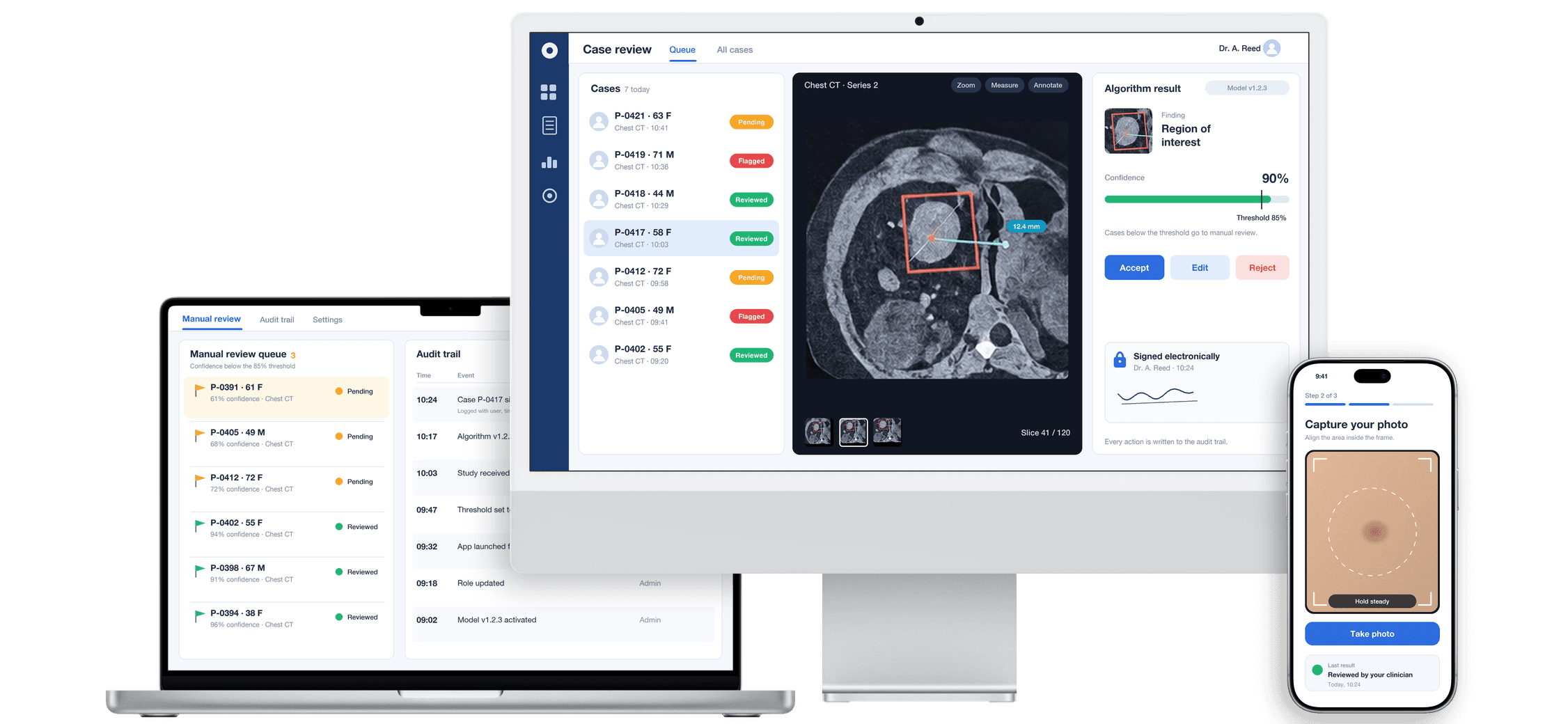
SaMD, ready for regulatory review from the first sprint
Software as a Medical Device (SaMD) is software with a medical purpose that works on its own, without a hardware device. Whether it analyzes an imaging study or delivers therapy through a phone, regulators treat it as a medical device, and the way it is built has to show that.
Orangesoft develops SaMD for medtech companies and digital health teams under an IEC 62304 lifecycle with ISO 14971 risk management. We classify the software with you, outline the FDA or EU MDR pathway, and build the product and its documentation together, so the evidence for your submission grows with the software.
SaMD development services we offer
Classification, development, documentation and post-market support from one team.
Request free estimate
SaMD development
We develop SaMD with clinician web apps, patient apps, algorithm services, and administration and audit features, built under an IEC 62304 lifecycle and an ISO 13485-aligned process. Requirements, design, code and tests stay traceable from the first sprint, so the software is ready for the documentation a submission asks for.

SaMD consulting and regulatory strategy
We write the intended use statement, classify your software under FDA Class I to III, EU MDR Rule 11 or IVDR, and outline the likely pathway, whether 510(k), De Novo, PMA, CE marking or no submission at all. Our architects help you decide what the first release has to include.

SaMD regulatory documentation and cybersecurity
Our team produces IEC 62304 lifecycle documents, the ISO 14971 risk management file and usability documentation as the software is built. For connected SaMD we add threat modeling, security testing and a software bill of materials (SBOM) for the FDA premarket cybersecurity documentation.

SaMD verification, validation and submission support
We write test protocols, run verification and validation, and document the results against your requirements and risk file. We then assemble the technical documentation for a 510(k) or CE submission and support questions from the regulator. The manufacturer files the submission, usually with a regulatory consultant.

AI-enabled SaMD development
We design, validate and release AI models for diagnosis and monitoring, with versioned model releases, confidence thresholds and manual-review queues for low-confidence cases. We also plan model updates under the FDA's predetermined change control plan (PCCP) guidance.

SaMD maintenance and post-market support
After release, we maintain your software, patch security issues and update the documentation as the product changes. When your regulatory plan calls for it, we add a post-market monitoring dashboard.
SaMD regulations and standards we design for
We prepare SaMD to meet the regulations and standards that apply to your product, your data and your target markets.
IEC 62304, ISO 14971 and IEC 62366-1
Software lifecycle (IEC 62304), risk management (ISO 14971) and usability engineering (IEC 62366-1) for medical devices.
ISO 13485 and FDA QMSR
Quality management for medical device manufacturers. The FDA Quality Management System Regulation (21 CFR Part 820) incorporates ISO 13485, and our process is aligned with it.
FDA pathways
510(k), De Novo and PMA.
EU MDR and IVDR
Classification and conformity assessment for the EU market, including Rule 11 of the MDR for software and the IVDR for in vitro diagnostic software.
FDA cybersecurity, PCCP and Good Machine Learning Practice
Threat modeling, security testing and SBOM for connected software. For AI-enabled software, good machine learning practice in development and a predetermined change control plan for updates.
HIPAA, GDPR, 21 CFR Part 11, HL7 FHIR and DICOM
Protection of patient data, electronic records and signatures, and exchange of clinical data and medical images.
SaMD solutions we deliver

Diagnostic SaMD
Software that helps detect or diagnose a condition from images, signals or patient data, such as analysis of imaging studies, skin or retinal photo analysis, and symptom assessment and triage. Risk classes range from I to III, depending on the claim.

Monitoring SaMD
Software that analyzes patient data over time, such as ECG and arrhythmia algorithms, glucose data analytics, and remote patient monitoring platforms with clinical alerts.

Therapeutic SaMD and digital therapeutics
Software that delivers or guides treatment, such as CBT-based programs for anxiety and depression, digital coaching for diabetes management, and app-based rehabilitation after stroke.

Clinical decision support and dosing
Software that recommends a care step or a dose, such as medication dosage calculation and risk scoring. Whether it is regulated depends on several criteria, including whether the clinician can independently review the basis for the recommendation and whether the software analyzes images or signals.
Software that is part of a physical device is covered in medical device software development.
What a SaMD platform actually costs
The first release of a Class II SaMD project we delivered, with its scope, team and budget.
A SaMD platform ready for FDA 510(k) submission in about nine months
- Budget, first release
- $378,740
- Timeline, first release
- 9 months
- FDA pathway
- 510(k)
Team
2 backend developers, 2 frontend and mobile developers, 1 quality assurance engineer with regulatory documentation experience, 1 project manager, 1 product owner / business analyst, plus a part-time regulatory consultant.
These are indicative figures based on Orangesoft's delivery experience, not a commercial offer. A binding estimate is produced after a discovery phase.
Request free estimateDelivered solution
- Clinician web appPatient list, case review, measurement and annotation tools, structured sign-off workflow
- Patient app (iOS & Android)Guided data capture, task reminders, results view, secure messaging
- Algorithm serviceInference pipeline, versioned model releases, confidence thresholds, manual-review queue for low-confidence cases
- Administration and auditRole-based access, full audit trail, electronic signatures, configurable clinical thresholds, encrypted cloud storage
- Regulatory work packageIEC 62304 lifecycle documentation, ISO 14971 risk management file, ISO 13485-aligned quality management system artifacts, cybersecurity documentation, verification and validation protocols, 510(k) submission support
Additional costs for the future release
- EU MDR submissionSecond market, on top of the FDA pathway
- On-premise deploymentDeployment option
- Multi-vendor EHR/EMR integrationNative integration with more than one vendor
- Post-market surveillanceMonitoring dashboard
SaMD integrations for clinical workflows
SaMD earns its place in care when it fits the systems clinicians already use.
EHR/EMR systems
We exchange patient data over HL7 FHIR and support SMART on FHIR app launch from the EHR, so results reach the clinical record and clinicians open the software from the systems they use without a separate login.
Hospital imaging
We ingest studies from hospital PACS over DICOM for software that analyzes images.
Laboratory systems
We exchange results with laboratory information systems over HL7 and FHIR, so diagnostic software works with lab data.
Wearables and connected devices
We bring sensor and device data into the algorithm service for monitoring and alerting.
Patient apps
iOS and Android apps with guided data capture, reminders, results and secure messaging.
Cloud and audit
Encrypted cloud storage with audit logging, role-based access and electronic signatures.
Technologies we use


How we work on your SaMD
Challenges we help you work through

Unclear classification
The same app can be Class I or Class II depending on what it claims. We write the intended use statement first and test it against the FDA and EU MDR rules, so scope and budget rest on the right class.
Documentation load
IEC 62304 and ISO 14971 documentation takes real effort. We produce it as part of development, with traceability from requirement to test, so the files grow with the software and are ready when the submission starts.

Cybersecurity evidence
Premarket submissions for connected software need threat modeling, security testing and an SBOM. We build them into the pipeline and keep them current as dependencies change.

Clinical evidence and usability
Validation and usability studies shape the schedule. We plan them early with your clinical and regulatory advisors and design the interface around the use scenarios the studies will test.
Our clients say it better






Why choose Orangesoft for SaMD development





Medtech experience
We have built healthcare software since 2011 and delivered 300+ products, including a Class II SaMD platform that reached 510(k) submission readiness in about nine months.

Regulation built in
IEC 62304, ISO 14971, FDA cybersecurity guidance, EU MDR and HIPAA shape the plan from the first session.

Senior team
A solution architect and a product manager with medical device experience lead the work.
Quality system
Our delivery runs on an ISO 9001:2015 certified quality management system, and our process is aligned with ISO 13485 and ISO/IEC 27001.
Questions you might have
Request free estimateHow much does SaMD development cost?
These are indicative figures. SaMD with limited claims and a light quality system typically costs $200,000 to $350,000+. Class II software on a 510(k) or EU MDR route typically costs $330,000 to $600,000+. The highest-risk or AI-driven SaMD typically costs $550,000 to $800,000+. The first release of the Class II project in the cost example above cost $378,740. A binding estimate follows a discovery phase.
How long does it take to bring SaMD to market?
It depends on the class, the scope and the review. The first release of our Class II project was ready for submission about nine months after kick-off. Review time after submission is set by the regulator and comes on top of development.
Where should we start if the class and the budget are still open?
Start with our free discovery for medical devices. In one week it gives you the likely FDA pathway, an architecture outline, an MVP scope, a roadmap and a budget range, with no obligation to continue.
Do we need a physical device for SaMD development?
No. SaMD is software that works without being part of a hardware device, so it can be built and tested on general-purpose platforms such as phones, browsers and cloud servers. If your software reads data from a sensor or a connected device, we need that device or its data format for integration and testing.
Do you prepare the regulatory submission?
We prepare the software-related documentation and support the submission, including lifecycle documents, the risk management file, verification and validation results, and cybersecurity documentation. The manufacturer files the submission, usually with a regulatory consultant. We do not give legal or regulatory advice.
More on SaMD from our blog
See more SaMD in focus: Navigating the compliance maze of Software as a Medical DeviceNavigate complex software as medical device regulations with confidence. From classification to market entry — everything health tech leaders need to know.
 FDA medical device classification: How to determine your device classUnsure how the FDA classifies your medical device? Learn how to identify your device class and choose the right submission pathway.
 IEC 62304 explained: Practical guide for SaMD developersLearn how IEC 62304 impacts SaMD development and how to apply it to meet safety, compliance, and investor expectations.
- 1. Intro callDuring a 30-minute meeting, our domain expert dives into your business and describes the steps for future collaboration.
- 2. Free discovery workshopTogether with you, our technical team defines the user flow, feature list, and project risks.
- 3. Project planningWe provide the implementation plan, timelines and estimations for your project.